The Face That Wouldn’t Behave: Taína H. Cruz Puts a Grin on Gansevoort Street

Reported Profile | Public Art and Contemporary Painting
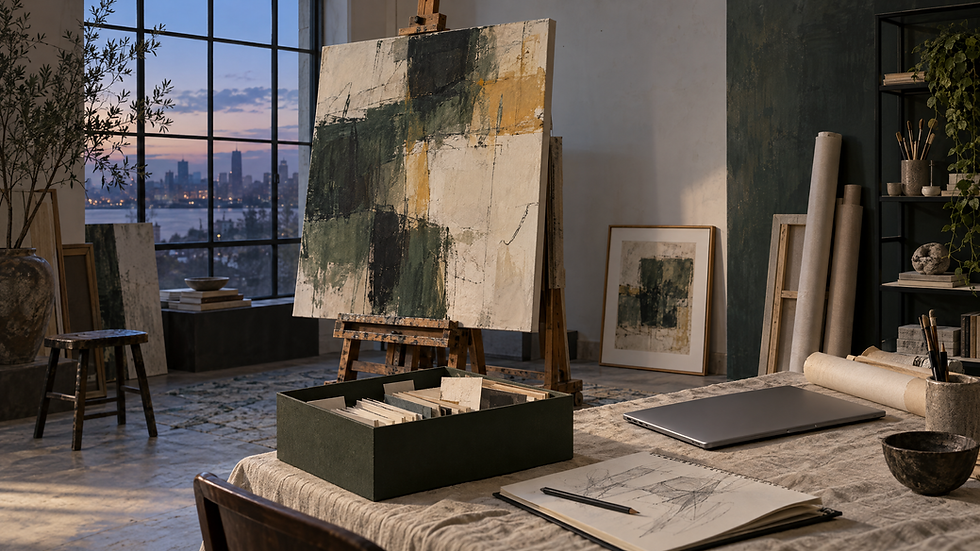
Image disclosure: This is an original editorial illustration, not a documentary photograph, artwork reproduction or exhibition view.
A green child’s face, scaled for the Whitney’s public edge, made a case for ambiguity as civic design. Taína H. Cruz’s 2026 project asks what happens when a painting returns a city’s gaze.
This profile is based on museum documentation and published reporting and interviews. It does not claim firsthand attendance.
In spring and summer, a close-up green face looked down Gansevoort Street from the building façade across from the Whitney Museum and the High Line. The painting was Taína H. Cruz’s I Saw the Future and It Smiled Back (2025), presented as the 2026 Biennial’s billboard project from 8 March to 20 September. The museum described it as carrying a “child-like sense of newness and anticipation.” [1]
That is a useful beginning, but not an adequate ending. In the Whitney’s audio guide, Cruz gave the work a more volatile temperature: the future can be beautiful and terrifying; the painting joins hope to danger, “like looking at the sun even when you know it might hurt your eyes.” She describes the child’s glow as a future that is close, breathing, and watching us as we watch it. [2] The reversal matters. The work does not simply transmit a future-facing message into the city. It makes the public face the uneasy fact that looking is reciprocal.
That reciprocity has a wider logic in Cruz’s practice. In a 2026 Rhizome profile, she described the internet in terms of feedback loops and connected that model to the exchange among body, image, and viewer. [9] The point does not turn the billboard into a tech allegory. It clarifies why its gaze is active rather than merely expressive: the image asks its viewer to enter a relation in which looking returns altered.
Cruz’s billboard has now come down, but its question remains unusually sharp for a public-art commission. A smiling child is one of visual culture’s most efficient assurances. Cruz denied the image that ease. The institutional description of anticipation is set against the portrait’s compressed particulars: green tonality, long light hair, exposed teeth, direct eyes. Lydia Eliza Trail, writing in Ocula, called the expression “a gleeful, joyful mania,” a grin that is almost a grimace. [3] Cruz herself told Trail that the eyes, teeth, and leer were intentional; a grin can carry sincerity, malice, humour, or uneasiness, and she wanted a passer-by to have to grapple with it. [3]
The difference between those accounts is not a disagreement so much as the project’s operating pressure. The Whitney offered a framework of newness; independent reporting retained the face’s unstable social charge. In a district accustomed to image management—retail windows, event graphics, architectural views arranged for the High Line’s forward motion—Cruz installed a portrait that refused to settle into welcome, warning, or branding. Its achievement was not that it made a building seem haunted. It was that it made a conventional public-facing surface look answerable.
A public image that will not become décor
A billboard is designed for speed. It gives a city an image before it gives it a thought. Cruz used that condition rather than pretending to escape it. The face’s scale and frontal construction mean that a viewer could register it at a distance; the teeth and eyes then complicate the read. The painting was not presented as a freestanding mural or an act of unsanctioned writing. It occupied the Whitney’s established billboard site, on the corner of Gansevoort Street and Washington Avenue, and was made possible by the museum with TF Cornerstone and the High Line. [1] That sanctioned setting is important: its force comes from being permitted, framed, and still difficult to domesticate.
The 82nd Biennial gave the project a resonant institutional setting. Its curators, Marcela Guerrero and Drew Sawyer, proposed an exhibition attentive to contemporary feeling and to the question of what it means to call something “American”; its 56 participating artists, duos, and collectives were described through technological affinities, shared mythologies, infrastructures, and other entanglements. [4] Cruz’s billboard turned that expansive programme into a single encounter with a face. Rather than illustrating a thesis about collective feeling, it tested one: Can ambivalence hold an urban public without being smoothed into a mood-board version of mystery?
The limit is real. A passer-by gets no gallery sequence, no wall text, no obligation to linger. On a billboard, an expression can be consumed as atmosphere before it is considered as a proposition. That risk is precisely what gives I Saw the Future and It Smiled Back its seriousness. A benignly smiling child would have solved the problem of public legibility. Cruz instead used the most legible device available—the grin—to stage a small failure of instant recognition. The work insists that an image can be public without becoming compliant.
The labour inside the apparent immediacy
Cruz’s relationship to graffiti is often shorthand for energy or rawness. The Whitney’s account is more exact. It identifies graffiti as a major inspiration, but it also records that Cruz conceived a drawing for a curved fifth-floor gallery wall, repeatedly practised it in the studio until it became a kind of muscle memory, and then executed it on site. The museum connects that directness to the exhilaration and fear the artist associates with growing up in New York. [5]
That process complicates the fantasy that an immediate mark has no preparation behind it. Muscle memory is neither spontaneity nor dead repetition. It is a technique for making a body carry an image through a specific architectural condition. In the Biennial, the on-site drawing appeared alongside works titled A Wall That Plays Along, Continuing Anyway, Passage, This Counts, Rest, Cast, and Studio Notes; installation documentation also identifies a projected animation and sculptural element in Cruz’s presentation. [5] [3] The billboard was therefore not an isolated leap to scale but one surface in a practice moving among wall, canvas, projection, and object.
Published accounts support that reading without making Cruz into a simple “digital native” parable. Trail reports that Cruz first worked with references from the digital realm and uses a computer to edit and mask video, while the artist says recent paintings have reached toward things the internet cannot contain. [3] In 2025, she appeared in Code Switch: Distributing Blackness, Reprogramming Internet Art at the Museum of Contemporary Art Detroit, a multi-sited project examining Black cultural production, computation, and new-media histories. [6] Those contexts make the billboard’s seeming plainness more consequential. Its pictorial bluntness is not a retreat from mediated images; it is an experiment in what mediation feels like when it meets a human-scale response to eyes and teeth.
The work also declines a stale divide between screen culture and an allegedly pure folklore. Cruz told Ocula that folklore is personal—something one carries—and spoke of symbols and motifs as internally perceived rather than decorative citations. [3] Her own account joins Caribbean folklore, contemporary digital image culture, and New York’s punk-goth sensibility without treating any as a style kit. This is less an iconography to decode than a method of refusing a fixed, hygienic self. The same face can be child, performer, omen, avatar, neighbour, or none of these securely enough to close the question.
The billboard’s direct address also has a prehistory in Cruz’s portraiture. Reviewing her 2023 Berlin solo exhibition Hound, Max L. Feldmann situated its faces amid the conditions of the selfie: self-display, scrutiny, and emotional illegibility bleed into one another. [10] The billboard carries that older problem outward. Its fixed grin is not a generalized sign of dread but part of a sustained inquiry into what a face can disclose once it has become an image made for circulation.
An institutional leap, not an arrival story
The rapid visibility of 2026 invites a familiar art-world simplification: a young painter gets a prominent exterior commission and becomes a new name to circulate. The actual trajectory is more uneven and more interesting. Cruz received an MFA from Yale in 2025, after a BFA from the Maryland Institute College of Art in 2020; records list solo exhibitions in New York, San Juan, and Berlin beginning in 2022, as well as appearances at MoMA PS1, MMK Frankfurt, and MOCAD before the Biennial. [7] Cultured reported that she was the youngest artist in the 2026 Biennial and was also included that spring in MoMA PS1’s Greater New York. [8]
The pairing of the Biennial gallery and street-facing billboard made that transition visible in a particularly compressed way. It placed an artist working across media in two differently public conditions: the slow, conditional looking of a museum interior and the involuntary looking of a sidewalk. In Ocula, Cruz resisted the tidy distinction between sculptor and painter, citing a childhood around the garment industry—both of her parents attended FIT—and the fluidity of what an artist can be. [3] That is a revealing claim, not because it supplies a lifestyle gloss, but because it names a practical resistance to disciplinary neatness. Her 2026 installation makes the point materially: a mark is rehearsed, a portrait is painted, a moving image is edited, and an architectural edge becomes a support.
Cruz’s present is not limited to the Biennial’s afterlife. Her second solo exhibition with Kraupa-Tuskany Zeidler, Pixie Theatre, is on view in Berlin through 7 November. The gallery frames its paintings as scenes governed by association rather than stable narrative, where recognition can turn enigmatic—a current, more extended setting for the instability the billboard concentrated at street scale. [11]
There is no need to make the billboard carry every history Cruz has named. The artist’s own accounts of African American and Puerto Rican family ties, summers in South Carolina, digital culture, and folklore are not an invitation to turn the face into a biography diagram. [3] The stronger reading stays with the formal problem. Cruz has made an expression that carries more signals than the viewer can reconcile at first glance. The portrait’s power lies in keeping that surplus visible.
Why the grin matters now
The most persuasive contemporary public art does not assume that access and agreement are the same. Cruz’s billboard was accessible in the literal sense: it sat outside the museum, available to people who did not enter the galleries. But it did not flatter the speed of the encounter. It offered a direct address and withheld a stable instruction for how to feel about it.
That is why the project deserves attention beyond the Biennial’s calendar. At a time when cultural institutions often speak in the soft language of participation, Cruz’s work proposes a harder form of contact: to be addressed by an image that neither confesses nor reassures. The future in her title does not arrive as a clean visual identity. It grins, watches, and makes the viewer responsible for the next interpretation.
Sources & records
1. https://whitney.org/exhibitions/taina-h-cruz "Whitney Museum of American Art: Taína H. Cruz, I Saw the Future and It Smiled Back"
2. https://whitney.org/guides/140?stop=14831 "Whitney Museum of American Art audio guide: Billboard, Taína H. Cruz"
3. https://ocula.com/magazine/conversations/taina-h-cruz-whitney-biennial-portrait/ "Ocula: Taína H. Cruz, There Are Many Ways to Challenge a Viewer with a Portrait"
4. https://whitney.org/exhibitions/2026-biennial "Whitney Museum of American Art: Whitney Biennial 2026"
5. https://whitney.org/exhibitions/2026-biennial/art?section=15 "Whitney Museum of American Art: Whitney Biennial 2026, Taína H. Cruz"
6. https://mocadetroit.org/exhibitions/code-switch-distributing-blackness-reprogramming-internet-art/ "Museum of Contemporary Art Detroit: Code Switch, Distributing Blackness, Reprogramming Internet Art"
7. https://www.k-t-z.com/artists/104-taina-h.-cruz/ "Kraupa-Tuskany Zeidler: Taína H. Cruz"
8. https://www.culturedmag.com/article/2026/03/04/art-taina-cruz-whitney-biennial/ "Cultured: Step Into the New Haven Studio of Taína Cruz, the Youngest Artist in the Whitney Biennial"
9. https://rhizome.org/editorial/2026/mar/23/artist-profile-ta%C3%ADna-cruz/ "Rhizome: Artist Profile: Taína Cruz"
10. https://elephant.art/no-escaping-the-nastiness-taina-cruzs-portraits-in-the-age-of-the-selfie/ "Elephant: No Escaping the Nastiness: Taína Cruz’s Portraits in the Age of the Selfie"
11. https://www.k-t-z.com/exhibitions/86-pixie-theatre-taina-h.-cruz/ "Kraupa-Tuskany Zeidler: Pixie Theatre, Taína H. Cruz"

$50
Product Title
Product Details goes here with the simple product description and more information can be seen by clicking the see more button. Product Details goes here with the simple product description and more information can be seen by clicking the see more button

$50
Product Title
Product Details goes here with the simple product description and more information can be seen by clicking the see more button. Product Details goes here with the simple product description and more information can be seen by clicking the see more button.
$50
Product Title
Product Details goes here with the simple product description and more information can be seen by clicking the see more button. Product Details goes here with the simple product description and more information can be seen by clicking the see more button.

Comments