The Artist’s Second Studio: Building an Art Business That Respects the Work
FIELD NOTE | ART & INDEPENDENCE
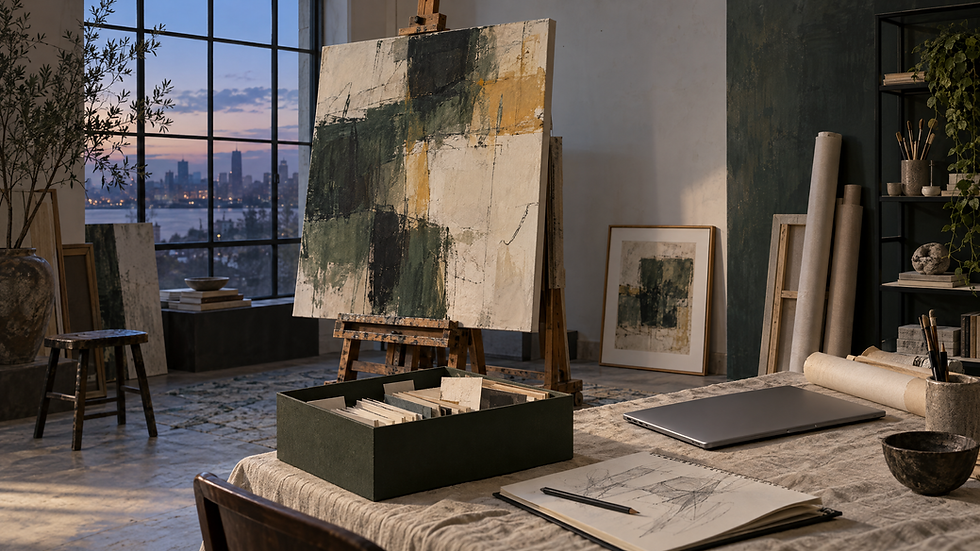
Image disclosure: This is an original editorial illustration, not a documentary photograph, artwork reproduction, or exhibition view.
An independent art practice needs more than a beautiful website or a lucky opening night. It needs a second studio: a quiet, well-run system for helping the right work find the right people—without allowing administration to consume the practice itself.
There is a point in many artists’ lives when selling the work starts to feel strangely intimate. Making something personal is one act. Naming a price, photographing it, answering the email, packing the crate, and following up after delivery is another. The fear is understandable: that the business side will flatten the work into merchandise, or that learning to sell will turn the artist into a permanently available version of themselves.
It does not have to.
The healthier ambition is not to become louder online or to make every painting serve an algorithm. It is to give the work a reliable structure around it. A collector should be able to understand what they are seeing, what it costs, whether it is available, how it will arrive, and how to remain in touch. The artist should be able to answer those questions without abandoning the time, privacy, and concentration that made the work possible in the first place.
That structure is the artist’s second studio. It is less glamorous than the first one, but it is often what allows the first one to survive.
A business is not a betrayal of the studio
For a long time, the romantic story of art has made money feel like an intrusion. Serious artists are expected to be devoted to the work; commercial artists are assumed to be distracted by the market. Real life is less tidy. Materials cost money. Space costs money. Time costs money. A practice that never asks how it will be sustained can leave the artist with fewer choices, not more freedom.
The point is not to manufacture a brand identity that has nothing to do with the art. It is to make the existing identity legible. What subjects recur? What atmosphere or question connects the work? Which kinds of rooms, homes, collections, or conversations does it belong in? Those are not cynical questions. They are questions of context.
Artist and author Carissa Potter makes an especially useful distinction in her account of building an art-centered business: before choosing a model, be honest about what you enjoy doing, what you can tolerate doing, and what you do not want to do at all. That clarity matters because a business built around daily video, constant commissions, or wholesale volume will drain an artist who wants to spend long, solitary stretches painting. There is no virtue in adopting a model that pays for a practice only by destroying its conditions.
A workable business should protect the source, not compete with it.
Begin with a real audience, not an imagined crowd
“Find your audience” is easy advice to give and hard advice to use. It is often misunderstood as an instruction to make art that pleases a demographic. It is not. The better question is: who already feels addressed by this body of work, and what helps them move from admiration to ownership?
The U.S. Small Business Administration recommends that a business test practical conditions such as demand, saturation, location, competition, and what customers pay for alternatives. An artist can use those questions without turning the studio into a focus group.
Start by looking at the evidence already in front of you. Which works produce the longest conversations in person? Which subjects bring people back to the studio, the website, or the mailing list? Do clients ask about originals, works on paper, commissions, editions, or work at a particular scale? What information do potential buyers ask for before they feel comfortable deciding?
The goal is not to chase every reaction. It is to notice the pattern between the art you are genuinely compelled to make and the people who understand why it matters. A practice becomes more durable when that relationship is named clearly.
Treat the website as a place of encounter
The website matters because it is the one place the artist can make coherent: the work, the context, the voice, the availability, and the invitation to stay in touch. It should not pretend to be a museum, a luxury retailer, or a giant marketplace. It should feel like a well-kept room.
That means the basics should be handled with care. A visitor should not need detective work to find a title, medium, dimensions, year, price or inquiry route, shipping expectations, and a short statement that explains the project without explaining it to death. The navigation should make sense on a phone. Images should be clear enough to reward attention. A sold work should remain part of the record when appropriate, marked honestly rather than quietly erased.
A commercial Art Storefronts article makes a useful—if promotional—case for treating an artist website as an active point of contact rather than a static online résumé. Its sales claims are not independent market evidence, but the underlying idea is sound: a direct channel gives the artist a place to present the work on their own terms. That does not mean rejecting galleries, fairs, designers, publishers, or platforms. It means not handing every relationship away by default.
Documentation is part of the artwork’s afterlife
Many artists maintain a studio archive in fragments: a phone album, a stack of invoices, a notebook, a cloud folder with names that made sense at 1:00 a.m. That is normal. It is also a place where a small amount of order can become genuinely valuable.
Give each finished work a reliable record. At minimum, capture the title, year, medium, dimensions, price, status, high-resolution image, and where it went if it sold. Keep notes on exhibitions, commissions, press, framing, editions, certificates, and relevant conservation details. Record the story cleanly while it is still easy to remember.
This is not a performance of importance. It is basic care for the work and for the person who may live with it. A collector who buys directly from an artist often wants more than an object; they want confidence that the object has a clear identity and history. An organized archive also protects the artist when a curator asks for a work list, a collector needs a replacement certificate, or a family member eventually needs to understand the practice.
Price with clarity, not theater
Art pricing is emotionally difficult because it asks the artist to put a number next to something that may have taken years of learning to make. There is no universally correct figure, and no ethical shortcut that guarantees a market.
Still, consistency matters. A price should make sense beside work of a similar size, medium, labor, and position in the artist’s own practice. It should be updated deliberately, not changed based on who happens to ask. It should take materials, presentation, framing, taxes, shipping, commissions, and the actual cost of continuing to work into account.
Pricing does not need to be hidden to appear sophisticated. Some artists prefer a clear price list; others use an inquiry model for particular bodies of work. Either can be appropriate if the process is respectful. What damages trust is making potential collectors feel embarrassed for asking, or making them guess whether a work is within reach.
A modest work on paper, an edition, or a smaller original can also be a meaningful entry point into a practice. The point is not to make everything cheap. It is to make the structure intelligible.
Protect the work before chasing visibility
Visibility is useful. Carelessness is not.
The U.S. Copyright Office explains that original artistic works are protected by copyright and that publication is not necessary for protection; it also notes that original art and photography on a website may be protected. That is a foundation, not a substitute for professional advice. An artist dealing with licensing, reproduction, contracts, trademark questions, or a suspected infringement should speak with an appropriate attorney or adviser.
In day-to-day practice, protection can be simpler: keep original files, preserve dated process documentation, state the terms for commissions in writing, retain records of what has been sold or licensed, and be thoughtful about how high-resolution files are shared. A clear, polite written agreement is rarely a sign of mistrust. It is often what keeps a promising relationship from becoming an avoidable misunderstanding.
Make room for the work to change
The strongest art businesses are not built around the premise that an artist will repeat one successful image forever. A practice grows. Materials change. Subjects disappear and return. New audiences may arrive through work that did not exist when the original plan was made.
This is why the second studio should be flexible. Review what is selling, but also review what is developing. Keep track of requests, but do not let requests become commands. Use the mailing list and the website to bring people into the evolution of the work—not merely to announce an item for sale.
The aim is not scale for its own sake. It is a practice with enough stability to remain alive, enough autonomy to remain truthful, and enough order that a collector can enter it with confidence.
A sustainable art business is not the moment the work becomes less personal. It is the moment the artist decides that the work deserves a life beyond the studio—and builds a respectful way for it to have one.
Sources & further reading
U.S. Small Business Administration, Plan your business: https://www.sba.gov/business-guide/plan-your-business/write-your-business-plan
U.S. Copyright Office, What Does Copyright Protect?: https://www.copyright.gov/help/faq/faq-protect.html
Carissa Potter, The Creative Independent, How to turn your art practice into a business: https://thecreativeindependent.com/guides/how-to-start-a-business-from-your-art/
Art Storefronts, How Valuable ART Businesses Are Built: https://blog.artstorefronts.com/go/how-valuable-art-businesses-built-lucky
This essay is for general information and cultural discussion; it is not legal, tax, financial, or investment advice.

$50
Product Title
Product Details goes here with the simple product description and more information can be seen by clicking the see more button. Product Details goes here with the simple product description and more information can be seen by clicking the see more button

$50
Product Title
Product Details goes here with the simple product description and more information can be seen by clicking the see more button. Product Details goes here with the simple product description and more information can be seen by clicking the see more button.
$50
Product Title
Product Details goes here with the simple product description and more information can be seen by clicking the see more button. Product Details goes here with the simple product description and more information can be seen by clicking the see more button.



Comments