The Studio Museum’s First New-Building Residents: What Institutional Care Actually Provides
Cultural Analysis
The first Artist-in-Residence cohort to work in the Studio Museum in Harlem’s purpose-built home makes the practical terms—and limits—of artistic support newly visible.
This is a records-based explainer drawing on the Museum’s published exhibition and programme materials, public funding records, and PBS NewsHour reporting. The writer did not attend the exhibition.
Original editorial illustration.
NEW YORK — October 13, 2026
An exhibition that begins before the gallery
A sustained becoming: Studio Museum Artists in Residence 2026, on view through January 3, 2027, presents Derriann Pharr, Simonette Quamina, and Taylor Simmons: the first Artist-in-Residence cohort to work in the Studio Museum in Harlem’s new building. In an art world inclined to measure support once work has acquired the clean edges of display, the sequence matters. This exhibition asks a prior question: what can a museum give an artist while the work is still unresolved, not yet folded into a career narrative or a collection?[1]
The institution’s new home at 144 West 125th Street opened in November 2025 after a seven-year construction closure. During that interval, the annual residency exhibition travelled to MoMA PS1; its return to Harlem is thus also the return of a working programme to the place meant to sustain it.[2] Independent reporting clarifies what the replacement was designed to remedy. The Museum’s former converted bank had no loading dock, a limited route for moving large work, and restricted public access.[8] Those are prosaic problems, but they shape artistic possibility. A wall that cannot receive a large canvas, a room that cannot admit a visitor, a building that makes a work hard to move: these are not merely technical failures. They set the terms of what an institution can imagine.
The new structure is therefore not simply a container for art. It is an argument about the conditions of cultural production: time, room, income, professional contact, and an audience. The Studio Museum was founded in 1968 in response to the inadequate recognition and collection of artists of African descent, as director and chief curator Thelma Golden explained to PBS NewsHour. Its Artist-in-Residence programme began the next year and has since counted more than 150 alumni.[2] [3] That long history invites broad claims about legacy. The present cohort offers a more exact subject: the practical infrastructure behind an artist’s capacity to continue.
The artists cannot be reduced to the building
The first obligation of writing about an institutional milestone is not to turn artists into evidence for it. The published record gives Pharr, Quamina, and Simmons distinct formal and historical concerns. Pharr, who lives and works in Birmingham, Alabama, uses mixed media to examine identity, memory, the body, and the American South. Her practice places figuration under pressure: its bodies are sites of self-regard, vulnerability, and revision. Quamina, a New York-based printmaker and draughtswoman, reconstructs personal and collective histories through monumental prints and graphite collages, addressing the inherited image of the Caribbean as much as its remembered and social realities. Simmons, who lives and works in New York, moves between painting, print, and drawing, using everyday scenes, music, found photographs, and online video as an unsettled vernacular archive.[2]
The exhibition’s institutional description places figuration, remembering, and dreaming across painting, collage, printmaking, drawing, sculpture, and mixed media.[1] That is a curatorial proposition, not a claim that the three artists speak with one voice or bear the burden of explaining Black art to a general public. Indeed, the Studio Museum’s historical importance lies partly in refusing the premise that art by artists of African descent constitutes a single aesthetic school. Golden made that point in the PBS report when she described a multiplicity of voices and ways of seeing.[3]
The value of a residency begins here. It cannot author content or manufacture an artist’s relation to form. It can create a buffer against the premature demand that emerging artists become legible as brands, representatives, or finished positions. The most consequential resource may be unglamorous: a room to work in without being moved along. In cultural policy, “support” often becomes a soft word, a vague atmosphere of encouragement. A residency either gives it hard edges or it does not.
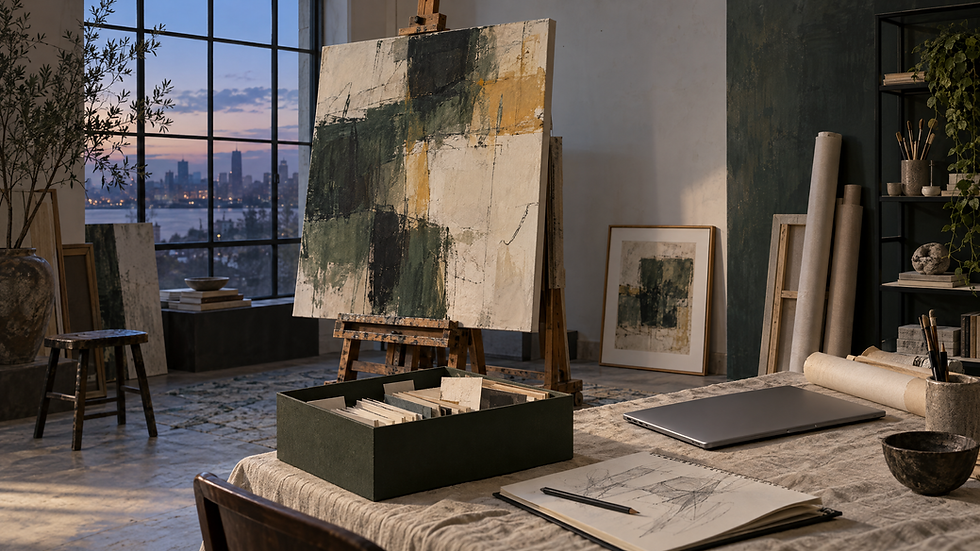
For this cohort, the Museum says those edges included individual studios in the J. Bruce Llewellyn Artist in Residence Center, a gathering lounge, interaction with curators and learning-programme participants, professional-development guidance, a culminating exhibition, and a publication. The residency ran from March 15 through October 15, 2026.[2] A studio protects concentration. A lounge admits the possibility of exchange without making collaboration compulsory. Staff contact can clarify procedures that institutions too often keep opaque. The exhibition and its publication carry the work into a public record. None guarantees a career; together, however, they make care something more exact than approval.
Architecture is a promise, not its fulfilment
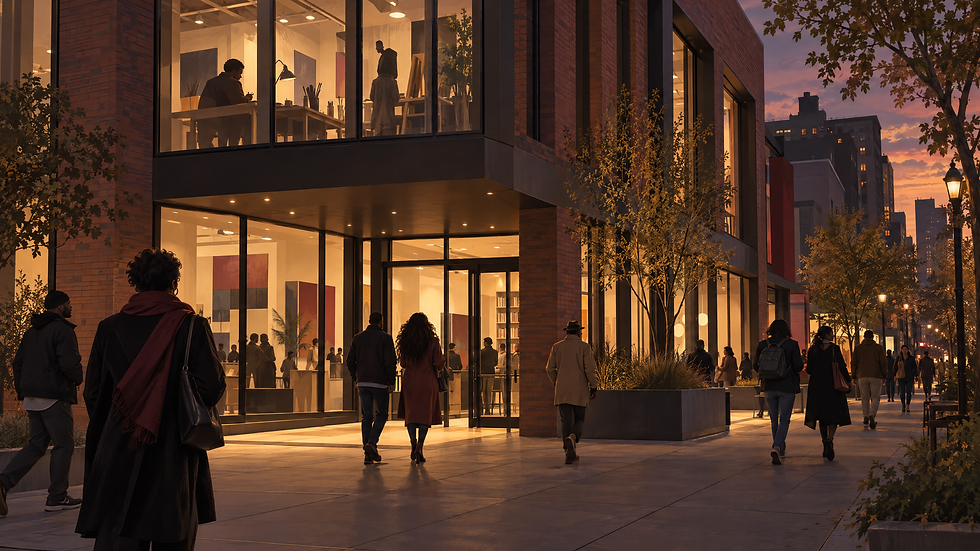
Architecture hardens that arrangement into space. The Museum says its 82,000-square-foot home more than doubles space for exhibitions and the residency, while indoor and outdoor public areas increase by almost 70 percent. Studios and education spaces sit beside galleries, an adjacency intended to encourage community exchange.[4] The $160 million, seven-floor project was a public-private undertaking, with $10.9 million in New York State support.[5] Such figures matter not because scale is a cultural virtue in itself, but because public and philanthropic money has helped establish a claim that the building must now meet.
Its most potent design gesture is public rather than private. The so-called “inverted stoop” turns an interior descent into tiered seating for talks, performances, film, and informal gathering. It recasts the brownstone stoop—a threshold where domestic and street life meet—as an institutional room. The Museum describes it as part of a building shaped by Harlem’s apartment windows, churches, and sidewalks.[4] Independent accounts support the seriousness of that ambition while supplying needed resistance to it. The Guardian documented a facility conceived to overcome an earlier building’s physical restraints, while The Architect’s Newspaper found the public-facing reverse stoop free to use but questioned how accessible it would prove in practice.[8] [9]
The reverse stoop is not the building’s only test of care. The project also bears a history of authorship that cannot be tidied into the institutional story: after three women credibly accused David Adjaye of sexual misconduct in 2023—allegations he denied—the Museum distanced itself from the architect, and Pascale Sablan, chief executive of Adjaye Associates’ New York office, shepherded the project to completion.[9] That history does not make the building’s public use a moral alibi. It presses the same question the residency does: who is protected, heard, and credited in the conditions of cultural production?
That reservation is the article’s essential tension. An open threshold is not the same as a shared institution. Proximity is a design decision, not evidence that exchange has occurred. Nor can more generous galleries shelter artists from the expenses and instability outside their walls. If a new museum is to be judged by more than its lobby, then its architecture must be read as a promise subject to public verification: Is studio time protected? Do school and neighbourhood programmes create sustained contact rather than extraction? Does exhibition-making document a process without forcing it into a premature conclusion?
Care has terms—and borders
The Museum’s current, now-closed application materials describe the next eleven-month residency cycle, from November 2, 2026, to October 3, 2027; they are not a retroactive account of the support given to Pharr, Quamina, and Simmons during their shorter March-to-October session.[6] Three emerging artists of African and/or Afro-Latinx descent receive round-the-clock private-studio access, staff engagement, a $50,000 stipend paid across the year, and a culminating exhibition. They must devote at least 20 hours a week to studio practice and participate in open studios, public programmes, and visits with community partners.[6] The programme accepts artists working in any medium; applicants do not need a project proposal or a degree. Its stated selection process involves Museum curators, external curators and artists, programme alumni, multiple rounds of review, and blind review.[6]
These mechanics distribute authority as well as money. Not demanding a project proposal means that applicants need not arrive having translated the future into an administratively tidy pitch. Blind review can curb some forms of recognition bias, though it cannot make a selective process universal. The programme has three places, not a solution to unequal access to work space or income. Its stated terms also make the limits plain: it provides no housing, and international artists must secure their own visas.[6]
Those limits should not be used to diminish a substantial stipend or dedicated studio. They are the border of the promise, and publishing them is part of what distinguishes accountable care from a charitable self-image. An institution that says what it will provide, what it will ask of artists, and what it cannot provide gives artists and the public something concrete to assess. The financial and social pressures on early-career artists do not disappear at a museum door; they enter the programme as facts of life.
Harlem is neither backdrop nor brand
The public stakes extend beyond the cohort. In the PBS report, former resident Jordan Casteel connected the programme’s reputation to a sense of belonging among artists. Golden, in turn, situated the reopening amid attacks on diversity programmes and disputes over whose histories public institutions should present.[3] On 125th Street, these are not disembodied debates. The Studio Museum sits in a neighbourhood whose cultural history cannot be made into ambiance for a capital project.
Independent architectural reporting locates the building on a thoroughfare that has long carried commerce, transit, protest, performance, and visual culture; it also records the Museum’s efforts to maintain channels with Community Board 10 during design.[9] Such history makes the new building’s rhetoric of openness more demanding, not less. The Museum runs free Sunday admission and programmes for families, children, and teenagers, alongside the spatial links among studios, learning rooms, and galleries.[4] [7] The meaningful measure is whether artists, neighbours, young participants, and visitors can meet without local life becoming a scenic proof of institutional relevance.
Readers can watch that measure before A sustained becoming closes. Look for how the forthcoming publication credits labour, process, and collaboration; whether open studios and public programmes establish sustained contact; and whether future residency materials keep disclosing the stipend, selection, housing, visa, access, and time commitments that make comparison possible. Institutional care is not a sentiment supplied after the fact. It is a set of resources, relationships, and responsibilities that the public can see—and hold to account.
Sources & records
[1] Studio Museum in Harlem, “A sustained becoming: Studio Museum Artists in Residence 2026.” https://www.studiomuseum.org/exhibitions/a-sustained-becoming-studio-museum-artists-in-residence-2026
[2] Studio Museum in Harlem, “Studio Museum in Harlem Announces 2026 Artist-in-Residence Cohort.” https://www.studiomuseum.org/press/studio-museum-in-harlem-announces-2026-artist-in-residence-cohort
[3] PBS NewsHour, “Inside the Studio Museum in Harlem’s showcase of Black art history in America,” February 2, 2026. https://www.pbs.org/newshour/show/inside-the-studio-museum-in-harlems-showcase-of-black-art-history-in-america
[4] Studio Museum in Harlem, “The Building.” https://www.studiomuseum.org/the-building
[5] New York State, “Governor Hochul Celebrates Opening of the Studio Museum in Harlem’s New Home,” November 14, 2025. https://www.governor.ny.gov/news/governor-hochul-celebrates-opening-studio-museum-harlem
[6] Studio Museum in Harlem, “Residency Application: Program Specifics and FAQs.” https://www.studiomuseum.org/residency/residency-application
[7] Studio Museum in Harlem, “Studio Museum in Harlem Announces Fall 2026 Season.” https://www.studiomuseum.org/press/studio-museum-in-harlem-announces-fall-2026-season
[8] David Smith, “Harlem has always been evolving: inside the Studio Museum’s $160m new home,” The Guardian, November 11, 2025. https://www.theguardian.com/culture/2025/nov/11/harlem-studio-museum-new-home
[9] Jerry Elengical, “Studio Museum pays tribute to Harlem with its first purpose-built home,” The Architect’s Newspaper, December 10, 2025. https://www.archpaper.com/2025/12/studio-museum-harlem/

$50
Product Title
Product Details goes here with the simple product description and more information can be seen by clicking the see more button. Product Details goes here with the simple product description and more information can be seen by clicking the see more button

$50
Product Title
Product Details goes here with the simple product description and more information can be seen by clicking the see more button. Product Details goes here with the simple product description and more information can be seen by clicking the see more button.
$50
Product Title
Product Details goes here with the simple product description and more information can be seen by clicking the see more button. Product Details goes here with the simple product description and more information can be seen by clicking the see more button.

Comments