Schiaparelli Before Viral Fashion: The Museum Politics of a Dress
The V&A’s Schiaparelli exhibition argues that fashion belongs in art history; its deeper lesson is that museums must make the many hands behind a celebrated garment visible.
This is a records-based analysis of official exhibition and collection material alongside independent reporting and criticism; it does not claim firsthand attendance or offer a conventional exhibition review.

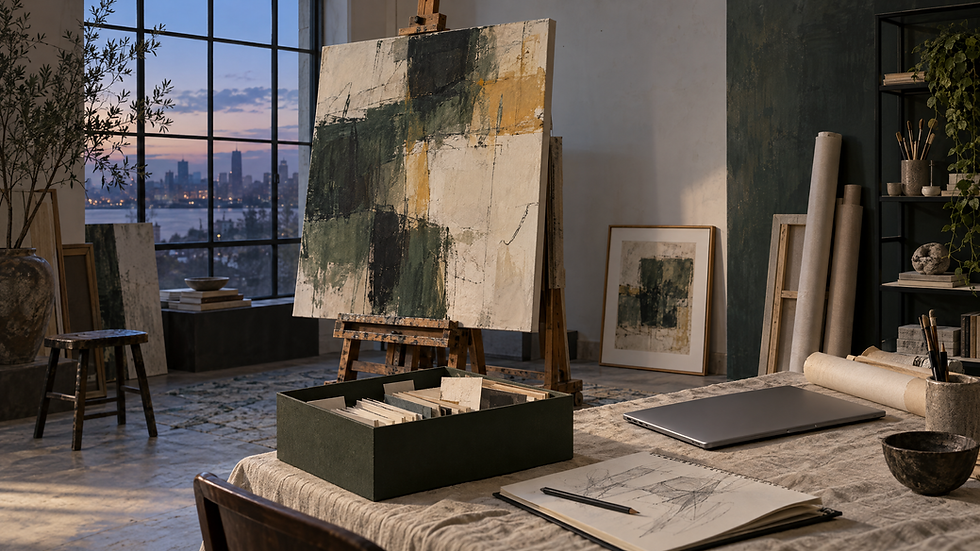
Cover: Original editorial illustration—not a documentary view or reproduction of a Schiaparelli garment, museum installation or artwork.
A different kind of attention economy
The Victoria and Albert Museum’s Schiaparelli: Fashion Becomes Art is in its final five weeks, with the museum currently listing Sunday, 15 November 2026 as its closing date and the exhibition as sold out; V&A members may visit free. The first UK exhibition devoted to Elsa Schiaparelli travels from the designer’s 1920s beginnings to the present house under Daniel Roseberry, and the V&A says it was made in collaboration with Schiaparelli. [1]
Its occasion is plainly contemporary. The exhibition assembles more than 400 objects, including 100 ensembles and 50 artworks, and sets the Surrealist-era designer beside Jean Cocteau, Salvador Dalí and Man Ray, then beside Roseberry’s couture. [2] The Guardian’s March preview framed Schiaparelli’s alliances with artists, theatre and cinema as an earlier apparatus for commanding public attention—something akin, in its own conditions, to social-media visibility. [3]
The comparison is perceptive, provided it does not make the interwar past a quaint rehearsal for the feed. Schiaparelli’s image-making was not an isolated act of style. It drew on a dense economy of drawings, textile knowledge, couture labor, photography, performance, clients and legal protection. Fashion becomes art, in this account, not because a garment startles, but because an object can carry a complicated set of social and technical decisions into public view.
The title’s apparently settled proposition still deserves pressure. “Becomes” announces cultural status, but also recalls what suits a body. Clothing takes meaning from movement, looking and use. On a mannequin, it gains sculptural stillness but risks losing the contingencies of wear. A strong fashion exhibition need not settle that tension; it should make it legible.
A coat has many authors
The 1937 evening coat associated with Schiaparelli and Cocteau is more revealing than any general claim about fashion’s status. The V&A identifies Schiaparelli as its designer and Cocteau as collaborator: his drawing generated the two profiles that resolve into a vase of roses across the coat’s back. Maison Lesage made the flat-strip embroidery, and the V&A’s conservation team prepared the object for display. [4] A coat of this kind is less a canvas with a famous signature than a relay between image, pattern, needlework, body and museum care.
The London record thickens the story. The V&A says the garment was designed in France and made in Britain. Its embroidery was probably produced in Paris; pieces then went to the Upper Grosvenor Street workroom, where roughly 80 employees finished and fitted it for Viscountess Castlerosse. [5] Those workers do not displace Cocteau or Schiaparelli from the story. They make the story true. The visual conceit only became couture through their material intelligence.
This is the point at which the institutional account and independent coverage usefully converge. CNN reported Sonnet Stanfill’s insistence that Schiaparelli’s relations with Surrealist artists were a “true collaborative, creative exchange,” not the simple application of art to clothing. [6] The proposition becomes convincing when the exhibition’s records retain the distinctions among conception, design, embroidery, manufacture, fitting and conservation. Without them, “collaboration” becomes a flattering blur around the best-known names.
The same standard should hold beyond the coat. The V&A lists the 1938 Tears and Skeleton dresses, conceived with Dalí, as historical anchors. [1] The Tears dress makes cloth seem torn; the Skeleton dress uses raised quilting to put anatomy on the surface. The Costume Society identifies the latter technique as trapunto. [8] Neither is merely a Surrealist picture transferred to cloth: each uses technique to disturb the body’s outline.
The fashion image is not the garment
The contemporary material makes this distinction more urgent rather than less. The V&A’s final section, A Golden Thread, presents Roseberry’s work as an extension of the house’s history; its press material points to recent looks associated with Ariana Grande and Dua Lipa. [2] Associated Press coverage likewise foregrounded the red-carpet garment worn by Grande at the 2025 Oscars. [9] Such loans offer a clear route for audiences who know the house through images already circulating online. They may also tempt the exhibition toward a simple continuity: Schiaparelli then, viral Schiaparelli now.
Celebrity dressing has always been part of fashion’s public machinery, and Schiaparelli’s own practice reached film performers and image industries. A museum can redirect attention from recognisability to construction: who designed the silhouette, built its support and supplied its surface; what the look means once it has left the premiere, photograph or publicity cycle.
SHOWstudio’s de la Haye supplies one useful corrective to the glamour story. Her account describes the display as a physical argument: repeated sightlines, theatrical surfaces, changing illumination, and two types of mannequin developed with bespoke padding and underpinnings. She reports that V&A mounting specialists worked with the maison’s heritage team for 18 months on the relationship between historical and contemporary garments. [7] Conservation and mounting are often successful precisely when visitors do not notice them. Yet they are not neutral acts. They establish posture, scale and the conditions under which a garment appears to possess its own agency. Naming that work teaches audiences to look past the charisma of a red-carpet provenance.
The same attention to mechanics does not settle the question of stagecraft. Muriel Zagha, writing in Engelsberg Ideas, finds the show’s cool-grey scenography too muted for Schiaparelli’s “enchanting oddness,” and considers Roseberry’s designs, scattered among the historical garments, a distraction. [10] The disagreement matters because it makes display an interpretive claim rather than a technical afterthought: should a museum frame Schiaparelli’s wit through restraint, or amplify it into a more surreal environment?
When the house is part of the frame
The V&A’s institutional position sharpens the responsibility. Its fashion collection is designated as the UK’s National Collection; the exhibition is curated by Sonnet Stanfill, Lydia Caston and Rosalind McKever. The four-part presentation includes Creative Constellations, devoted to Schiaparelli’s artistic networks, and A Golden Thread, which brings the narrative to Roseberry’s work. [2] A national museum does not merely preserve objects here. It determines which relations will be remembered as art history.
Independent criticism complicates the official frame in a productive way. In a SHOWstudio review, fashion historian Amy de la Haye—who notes her former V&A curatorial role—describes research into British fabrics and London’s fashion industry, and reports that specialist mounting staff worked with the house’s heritage team for 18 months to devise mannequins, padding and underpinnings for the historical and contemporary garments. [7] That is material context readers should demand: a couture silhouette in a gallery is not self-evident. It is an achieved condition, sustained by technical judgment as much as display rhetoric.
The museum has disclosed that the exhibition was created in close collaboration with Schiaparelli, and has named its exhibition designer, Nebbia, and supporters, including Tia Collection, Kathryn Uhde and Revolut. [2] Such disclosure is not evidence of improper influence. It is the minimum condition for a clear-eyed reading of a show in which a public institution studies a living luxury house with its own inheritance to narrate. The question is not whether a museum should work with a brand, but whether the terms of that relationship leave the historical record legible.
The Costume Society’s Jane Francis, writing from a specialist perspective, finds the exhibition attentive to texture, embroidery, fastenings and prints but still weighted toward finished outcomes; she wanted more sketches, iterations and technical development. [8] That is not a minor request for backstage romance. Process is where authorship becomes specific, where an artist’s proposition meets a maker’s constraint, and where a museum can resist turning labor into atmosphere.
The criticism also points to a larger art-historical correction. Independent coverage tends, understandably, to organize Schiaparelli around Dalí and Cocteau: their names offer a ready-made bridge from couture to canonical modern art. The V&A’s own account, however, records a wider field that includes Leonor Fini, Meret Oppenheim, Elsa Triolet, Alberto Giacometti and Jean Schlumberger. [2] De la Haye argues that the exhibition extends its account of collaboration toward female artists, clients and creative peers, rather than retaining the older model of a female couturière authenticated by male genius. [7] This is not a matter of adding overlooked names to an unchanged hierarchy. It is a question of whether the museum can describe fashion’s social world as a network of patrons, portrait subjects, artisans, sellers and designers—all of whom influenced what could be imagined and worn.
For this reason, the London chapter deserves attention beyond its novelty. The branch opened in Mayfair in 1933, offering British clients an alternative to purchasing imported Paris couture and connecting the house to local manufacturers and fashion workers. [5] The V&A notes that Schiaparelli had long used Scottish wool, Irish linen and tweed, which makes “Schiaparelli London” more than a branch-office tale. [5] It provides an account of design moving through materials, customs rules, labor markets and particular places. This is the scale at which a museum can connect avant-garde style to public history without reducing either to décor.
Archives instead of nostalgia
Schiaparelli’s London operation also shows that authorship had a commercial and legal life. The V&A records that the company registered dozens of designs with the British Board of Trade between 1935 and 1939 to guard against copying; the registrations enabled legal action, though the museum has found no evidence of a British copyright lawsuit brought by Schiaparelli. Related photographs are available for consultation in the museum’s study room by appointment. [5] The archive changes the scale of the story. It locates Surrealist wit within contracts, reproductions, workshop schedules, client fittings and a transnational business rather than outside them.
That is the public stake of calling design art. It is not a demand that every dress receive the prestige traditionally reserved for painting. It is a demand for a richer account of how culture is made—and for credit that does not evaporate once a famous artist or a current red-carpet wearer enters the frame. Students, makers and general audiences gain more from a label that distinguishes “designed by,” “embroidered by,” “made by,” “worn by,” “photographed by,” “lent by” and “conserved by” than from another claim that fashion has crossed an already unstable boundary.
Before the exhibition closes, the useful thing to watch is therefore not only the celebrated lobster, skeleton or face-and-rose motif. Watch the credits around them: the techniques named, the collection or lender identified, the work that is dated, and the work left unnamed. In those small lines, a museum can turn spectacle into durable public knowledge.
Sources & records
[1] V&A: Schiaparelli: Fashion Becomes Art exhibition record — https://www.vam.ac.uk/exhibitions/schiaparelli
[2] V&A: Schiaparelli exhibition extended press release — https://vanda-production-assets.s3.amazonaws.com/2026/03/24/18/00/28/4a106fbe-e1cb-457b-a671-d33e3e5a183d/VA%20Schiaparelli%20Press%20Release%20Extended%204.pdf
[3] The Guardian: Artist, impresario, couturier: V&A to stage Schiaparelli retrospective — https://www.theguardian.com/fashion/2026/mar/06/artist-impresario-couturier-v-and-a-to-stage-elsa-schiaparelli-retrospective
[4] V&A: Exploring an iconic embroidered evening coat: Schiaparelli x Cocteau — https://www.vam.ac.uk/articles/exploring-an-iconic-embroidered-evening-coat-schiaparelli-x-cocteau
[5] V&A: Schiaparelli London Ltd: Paris chic crosses the Channel — https://www.vam.ac.uk/articles/schiaparelli-london
[6] CNN: A blockbuster exhibition explores how surrealist designer Elsa Schiaparelli redefined fashion — https://www.cnn.com/2026/03/28/style/elsa-schiaparelli-exhibition-vamuseum
[7] SHOWstudio: Review: Schiaparelli: Fashion becomes Art — https://www.showstudio.com/news/review-schiaparelli-fashion-becomes-art
[8] The Costume Society: The Shocking Schiaparelli: On view at the V&A — https://costumesociety.org.uk/blog/post/the-shocking-schiaparelli-on-view-at-the-va
[9] Associated Press: Lobsters and red carpet gowns: A new show celebrates Schiaparelli’s surrealist fashion — https://apnews.com/article/va-museum-schiaparelli-fashion-exhibition-2b509cd0f3df9c7dc19bcc6b57dad220
[10] Engelsberg Ideas: Elsa Schiaparelli’s baroque fantasy — https://engelsbergideas.com/reviews/elsa-schiaparellis-baroque-fantasy/

$50
Product Title
Product Details goes here with the simple product description and more information can be seen by clicking the see more button. Product Details goes here with the simple product description and more information can be seen by clicking the see more button

$50
Product Title
Product Details goes here with the simple product description and more information can be seen by clicking the see more button. Product Details goes here with the simple product description and more information can be seen by clicking the see more button.
$50
Product Title
Product Details goes here with the simple product description and more information can be seen by clicking the see more button. Product Details goes here with the simple product description and more information can be seen by clicking the see more button.


Comments