Table for Three: Salman Toor Rehangs the Courtauld’s Social World

Reported profile | Visual-culture analysis
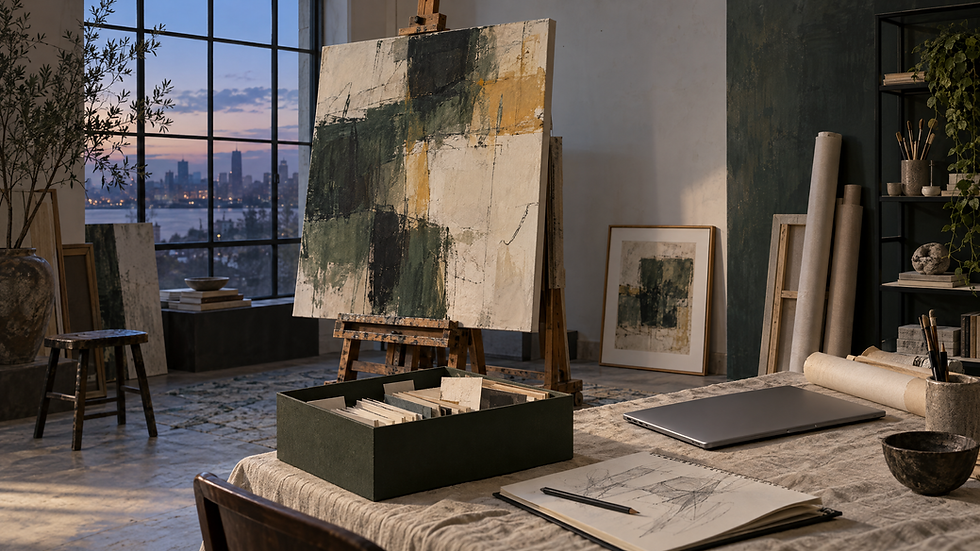
Image disclosure: This is an original editorial illustration, not a documentary photograph, artwork reproduction or exhibition view.
At Somerset House, the Pakistani-born, New York–based painter turns the bar, the cab and the dinner table into sites where art history’s promise of visibility meets its price.
This report is based on exhibition records, collection documentation and published independent criticism; it does not claim firsthand attendance.
The Courtauld Gallery’s Salman Toor: Someone Like You begins with a proposition that is formally modest and institutionally charged: 19 paintings made between 2019 and 2026, installed in the gallery’s temporary rooms while the collection’s Old Masters and Manet remain close at hand. It is Toor’s first solo museum exhibition in Europe, and it runs from 2 October to 10 January 2027. A concurrent display of drawings extends the encounter beyond the exhibition galleries. [1] [2]
The occasion matters because Toor’s subject is not simply identity rendered visible. His paintings ask what it costs to join a room, to be watched in it, and to leave it. Their recurring furniture—bar counters, restaurant tables, a taxi’s back seat, a dresser, the impromptu still life of belongings exposed at a checkpoint—does more than furnish scenes of contemporary queer life. It measures the terms on which people may appear together. In the Courtauld’s setting, those terms are sharpened by a collection built around the great European paintings through which social types, bodies and interiors have so often been made legible.
The institution’s framing is hospitably broad: friendship and love sit alongside solitude and alienation, while Toor describes his figures as queer and immigrant lives suspended between "intimacy and exposure, belonging and estrangement." He adds the crucial qualification: there are "daily costs associated with visibility." [1] The most persuasive reading of the show takes that last phrase seriously. Toor is not asking the museum to certify an already coherent community. He makes the very mechanics of painting—composition, colour, borrowed gesture and the viewer’s point of view—register the pleasures and hazards of being seen.
A bar, a mirror, a public
The hinge is The Bar on East 13th (2019), an oil on panel made after Toor’s 2017 visit to the Courtauld. The painting revisits Édouard Manet’s A Bar at the Folies-Bergère (1882), which remains in the permanent collection. [1] The premise could have yielded an easy before-and-after: the canonical Parisian night spot recast as downtown New York. Instead, the relation is more useful when understood as an argument about spectatorship.
Manet’s last major painting sets the barmaid Suzon before a mirror that sends the crowd, circus entertainment and a male customer back toward the viewer. The reflection is deliberately wrong-footed: figures and bottles do not line up cleanly, and the woman seems at once attended to and alone. [3] In Toor’s version, the historical allusion makes the bar an inherited apparatus for arranging proximity. Who is working, who is looking, who is carried by a crowd, who is left at its edge? The reference carries Manet’s unstable public into a scene of queer sociability without pretending that the two settings share the same stakes.
That distinction is where the current exhibition becomes more than a deft art-historical dialogue. The visitor is not always granted the role of companion. In Man With Face Creams and Phone Plug, the scene is composed from the immigration officer’s side of the counter: the arrangement makes the viewer’s gaze share the authority that sorts an ordinary cache of toiletries and electronics. [9] [10] It is an adjustment that prevents the lushness of these paintings from becoming a haze of atmosphere. Toor’s green palette is not a brand identity. It is a visual climate in which attraction and surveillance can coexist.
The social world is therefore not a carefree tableau. In Man With Face Creams and Phone Plug, grooming products lose their private, daily ease and become an inventory. [10] In Citizens, two men bring a hand to the chest; the title makes a gesture that might read as romance or solidarity brush against the language of civic allegiance. [11] Such works give concrete form to the exhibition’s larger claim about belonging. They also resist a consoling version of representation in which painting repairs exclusion merely by admitting new protagonists.
The old masters are not a backdrop
Toor’s relationship with art history is sometimes summarized as a citation practice: Manet here, a Renaissance tondo there, an Old Master gesture reframed for the present. The summary is accurate but too thin. His education as a painter passed through sustained copying of baroque, rococo and neoclassical pictures before encounters with the work of Amrita Sher-Gil, Bhupen Khakhar and Colin David; those South Asian genealogies matter as much as the European ones. [5] The Courtauld is not a neutral storehouse that Toor raids for quotations. It is a setting in which multiple lineages of figure painting are made to press against the institutional story called "the canon."
This is also the point at which the independent accounts are more revealing than the official language of belonging. Apollo identifies both the verdigris-lit nightlife pictures and the grimmer checkpoint scenes as defining poles of the practice. [5] Time Out’s account adds the physical variety: thick, parallel green strokes in The Women; the large Ghost Ball (2023), on loan from the Pinault Collection and informed by an Indian miniature of dancers; and Lunch (2019), a circular painting whose Renaissance format contains the cool light of a phone screen. [6] Read together, these accounts describe a painter who does not borrow prestige from the past so much as test the past’s compositional systems under new social pressure.
A table makes that test unusually clear. In Lunch, a cold phone screen sits within a circular composition that invokes Renaissance roundels. [6] The image makes a setting feel intensely specific without turning it into ethnographic evidence. A meal, like a party, is an occasion for looking, posing, withholding and belonging imperfectly. The title of this profile is not a claim about the picture’s seating plan; it names the painter’s recurring problem. How can people occupy an image together without becoming a type, a token or a seamless emblem of community?
His 2020–21 Whitney Museum exhibition, How Will I Know, established the terms of that problem in paintings of imagined young queer Brown men living between New York and South Asia. The Whitney described a method that joins academic technique to a quick, sketch-like touch: lush interiors of friends, puppies and phones sit against more muted scenes of public vulnerability, including airport scrutiny. [7] Since then, Toor has returned to historical collections with particular purpose—placing Museum Boys near Vermeers at the Frick in 2021 and making van Dyck-inflected paintings for a 2022 Baltimore Museum of Art solo, according to Ocula. [8] The Courtauld show is thus not a sudden coronation but the latest, unusually concentrated version of a working method: paint contemporary life into the spaces where art history already governs attention.
Drawing, then disarray
The concurrent works-on-paper display makes the method easier to see without reducing painting to preparation. It also makes a recent accession part of the exhibition’s argument: Fag Puddle in Vitrine (2021), acquired by the Courtauld in 2024, appears in the display, and ArtReview reports that the acquisition was an indirect impetus for the current show. [1] [9] The Courtauld identifies ink, charcoal and gouache as its materials; recurring motifs include groups at border control, still lifes and reworked historical scenes. Three Mascots (2023), for instance, follows Pieter Bruegel the Elder’s grisaille The Three Soldiers. [2] Toor has described drawing as second nature, and the institution notes that remembered faces of friends and acquaintances often inform images that otherwise originate in imagination. [2]
That is a useful corrective to the assumption that the paintings’ charisma comes only from colour. Drawing gives them a mutable cast: bodies bunch together, posture hardens under a gaze, a hand can become a pledge or a performance. It also permits the oddness that protects the work from becoming illustration. The new, Courtauld-commissioned Fag Puddle with Carriers (2026) is modelled on Lorenzo Lotto’s The Entombment in the collection; its figures carry body parts, but the resulting image is neither devotional quotation nor tidy allegory. [12] It retains the collision of comedy, menace and formal pleasure that a polished story of inclusion would have to smooth away.
There is, however, a productive limit to the Courtauld encounter. To hang Toor near Manet and Lotto is to acknowledge that queer, immigrant and diasporic lives belong in painting’s history. But museum proximity can also make difficulty look settled: a radical social world converted into a sanctioned viewing experience, neatly divided between permanent collection and temporary show. Toor’s strongest pictures do not let that conversion close. Their rooms are sheltering but permeable; their tables make company possible but never guarantee it; their glances return the viewer to the unease of looking.
That is why this show deserves attention now. At a moment when institutions can too easily treat representation as a completed task, Toor offers a more demanding proposition. Painting is not a ceremonial place at the table. It is the table’s unstable arrangement of bodies, invitations, mirrors, objects and exits. The Courtauld has supplied an exacting historical setting for that argument. Toor’s accomplishment is to ensure that its old social worlds do not remain safely in the past.
Sources & records
1. https://courtauld.ac.uk/whats-on/exh-salman-toor-someone-like-you/ "The Courtauld: Salman Toor, Someone Like You"
2. https://courtauld.ac.uk/whats-on/exh-salman-toor-drawings/ "The Courtauld: Salman Toor, Drawings"
3. https://courtauld.ac.uk/highlights/a-bar-at-the-folies-bergere/ "The Courtauld: Édouard Manet, A Bar at the Folies-Bergère"
4. https://www.nytimes.com/2026/10/06/arts/salman-toor-courtauld-gallery-london.html "The New York Times: In This Painter’s Seductive World, the Past and Present Meet"
5. https://apollo-magazine.com/salman-toor-someone-like-you-courtauld-london-preview/ "Apollo: Salman Toor, Someone Like You"
6. https://www.timeout.com/london/art/salman-toor-someone-like-you "Time Out: Salman Toor, Someone Like You"
7. https://whitney.org/exhibitions/salman-toor "Whitney Museum of American Art: Salman Toor, How Will I Know"
8. https://ocula.com/magazine/art-news/salman-toor-to-see-first-solo-show-in-europe-/ "Ocula: Salman Toor to See First Solo Show in Europe Next Year"
9. https://artreview.com/salman-toors-laws-of-attraction-someone-like-you-courtauld-gallery-london-feature-shaunak-mahbubani/ "ArtReview: Salman Toor’s Laws of Attraction"
10. https://whitney.org/essays/salman-toor-self-as-cipher "Whitney Museum of American Art: The Self as Cipher: Salman Toor’s Narrative Paintings"
11. https://courtauld.ac.uk/news-blogs/2026/5-things-to-know-about-salman-toor/ "The Courtauld: 5 things to know about Salman Toor"
12. https://www.theartnewspaper.com/2026/10/13/salman-toor-courtauld-gallery-exhibition-runs-the-emotional-gamut-from-convivial-to-fraught "The Art Newspaper: Salman Toor’s Courtauld Gallery exhibition runs the emotional gamut from convivial to fraught"

$50
Product Title
Product Details goes here with the simple product description and more information can be seen by clicking the see more button. Product Details goes here with the simple product description and more information can be seen by clicking the see more button

$50
Product Title
Product Details goes here with the simple product description and more information can be seen by clicking the see more button. Product Details goes here with the simple product description and more information can be seen by clicking the see more button.
$50
Product Title
Product Details goes here with the simple product description and more information can be seen by clicking the see more button. Product Details goes here with the simple product description and more information can be seen by clicking the see more button.


Comments