A Minor Key for the Museum Vault: Pio Abad’s Hand-Drawn Afterlives

Reported Profile | Museum and Visual Culture
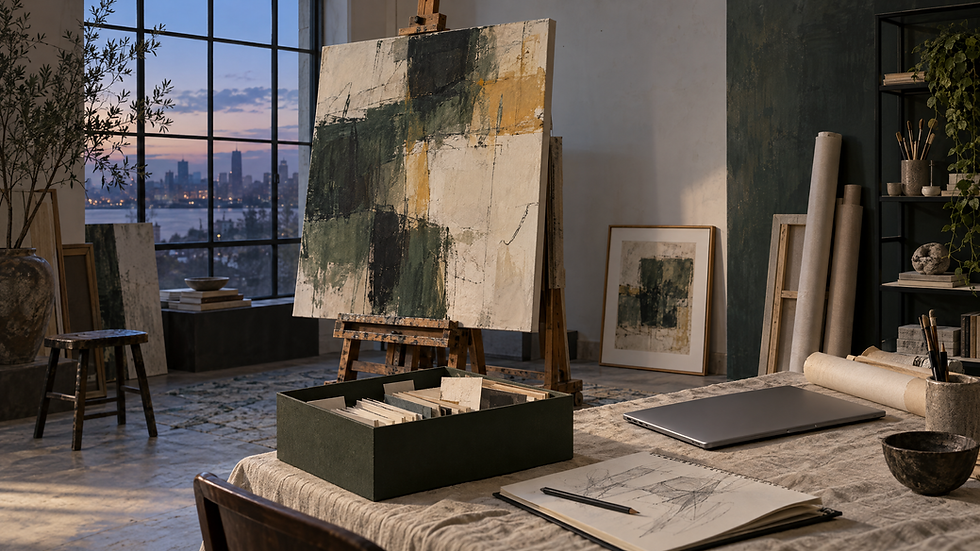
Image disclosure: This is an original editorial illustration, not a documentary photograph, artwork reproduction or exhibition view.
At the Venice Biennale, the Manila-born, London-based artist makes drawing a way to measure what the museum cannot settle: the distance between an object’s catalogue life and the lives it displaced.
This source-led analysis considers Pio Abad’s 2026 Biennale presentation through published interviews, institutional records and independent criticism; it is not based on an on-site visit.
The smallest instrument in Pio Abad’s Venice Biennale presentation is a 0.3-millimetre pen. It is also the means by which the artist makes the museum’s grandest claims—classification, custody, historical neutrality—look newly contingent. In the Central Pavilion of In Minor Keys, on view through 22 November, Abad brings together ink drawings from 1897.76.36.18.6 (2023–26), his to-scale rendering of the underside of “Powhatan’s Mantle,” and Banua (2026), a new fabric work. The exhibition’s official account is concise about the wager: drawings of objects held by museums are brought into relation with domestic things, craft and a private scale of attention. [1]
It would be easy to call this an art of restitution, but that would make it sound too settled. Abad cannot return a Benin bronze with a sheet of paper, nor does he pretend that a painstaking image neutralises the violence of a collection. Instead, he puts pressure on the habits that make objects seem knowable once they have been accessioned, photographed and placed behind glass. The result is not a cleaner history. It is a demand to notice the structures by which one object becomes an artefact and another remains, merely, stuff in a home.
A drawing before a claim
Abad’s drawings are not casual acts of looking. In a 2026 conversation for Burlington Contemporary, he described a procedure that begins with a photograph—taken or found—enlarged to the scale of the paper. Carbon paper makes coordinates; the pen follows. The method converts a thing into a grid of decisions before it becomes an image again. He called drawing a way of slowing things down, and said that in this process an object becomes “more like a series of coordinates.” [3]
That technical sequence matters. It declines the quick authority of the collection photograph, yet does not claim a privileged, unmediated intimacy with its subject. The photograph, carbon transfer and hand are all present in the final result. What looks devotional is also procedural. Vogue Philippines reports that Abad spent roughly five months on the Venice works, using the fine pen to render stitches, knots, cracks and buttons; some drawings approach two metres in height. [2] Enlargement is therefore not a simple magnification of museum detail. It is a way of making duration visible.
The title 1897.76.36.18.6 has the bureaucratic cadence of a collection number by design. Abad says it joins the year of the British punitive expedition to Benin with his own address, in the former Royal Arsenal stores at Woolwich; the series sets British Museum Benin bronzes beside measured stacks of belongings from his home. [5] [1] In a 2024 review, Crystal Bennes noted the friction this produces: a jar of Nutella can register a history of palm-oil deforestation in Nigeria, while a personal photograph carries another register of loss. [4] The domestic pile does not sentimentalise the bronze. It refuses the false distance between imperial extraction and ordinary consumption.
There is a useful severity in that refusal. A catalogue can make a work of art seem complete by giving it a name, material, date and ownership trail. Abad borrows the catalogue’s visual discipline—scale, outline, inventory—and makes it incapable of closing the case. Each domestic companion changes the bronze’s field of reference without standing in for it. The drawings ask a question that collection databases usually avoid: what relations remain outside the record but inside the object’s afterlife?
The reverse side of a collection
The Venice presentation extends a research trajectory that became unusually public in 2024. To Those Sitting in Darkness, Abad’s Ashmolean NOW exhibition in Oxford, placed his new drawings and objects beside selected works by other artists and ‘diasporic’ objects he had researched and chosen from Oxford collections; it was one of the four presentations nominated for the 2024 Turner Prize. [6] [7] The recognition matters less as a career trophy than as evidence of the scale of the institutional conversation he had already opened: the artist was not simply borrowing archive material as visual texture but asking what histories museums had made difficult to see.
The most direct return from Oxford is I am singing a song that can only be borne after losing a country (2023), a life-size drawing of the underside of the deer-hide object commonly called “Powhatan’s Mantle,” held by the Ashmolean. The Biennale identifies the work as both a transcription and a lament for the histories of dispossession associated with it. [1] Frieze described the original red-pencil and carbon-transfer drawing as 2.4 by 1.8 metres, tracing cracks and contours on the reverse of the mantle rather than repeating its better-known front. [4]
That choice of reverse is a formal decision with political force. It denies the museum display its usual frontal promise: the idea that looking has delivered the thing. Yet the work’s value lies precisely in what it does not solve. Bennes’s review makes the necessary caution plain: inviting an artist to recontextualise a collection is not, by itself, the decolonisation of a colonial institution. [4] Abad’s drawing does not return the mantle, repair an accession history or transform a repository into an equal meeting ground. It interrupts the fluency of display. That is substantial, but it is not the same as redress.
This limit gives the work its seriousness. Many contemporary museum interventions turn historical injury into an atmospheric prompt for viewers to feel alert, then leave. Abad puts a slower, less easily consumable labour in the path of that response. To look at the drawn reverse is to attend to a surface that was already there but not necessarily meant to be the public face. The act remains one of representation, with all representation’s limits; it is also an argument that the back of an object may be where a history begins to resist its label.
Banua, or the risks of kinship
If the mantle drawing tests what it means to face a collection object, Banua tests what it means to let a reference change medium. The official account says the work responds to a woman’s top made from mother-of-pearl buttons in Chicago’s Field Museum collection, which holds many objects from the Philippines. [1] Vogue Philippines reports that this monumental work is the first time Abad has taken his drawing practice onto fabric rather than paper. [2] The change is not decorative. It carries a language of stitch, drape and assembly into a practice previously governed by a paper surface and a measured line.
The title also refuses a fixed map. Abad told Vogue that banua or banwa travels across Austronesian languages, its meaning shifting among harbour, celestial space and time according to place. [2] This is not a licence to compress an archipelago’s differences into a pleasing image of connection. It is the tension that makes Banua more persuasive: the work’s cosmological and archipelagic associations, as the Biennale’s text has it, are grounded in a specific museum garment and its material grammar of mother-of-pearl buttons. [1]
The risk of any aesthetic of kinship is that similarity begins to feel like proof, or that a museum’s disparate holdings become available for a new, frictionless poetry of diaspora. Abad is strongest when the seams remain visible. Fabric gives him another way to insist on relation without declaring equivalence—between an object held in Chicago, a hand-drawn practice developed in London and a Biennale staged in Venice. What travels is not a stable essence but an account of how matter, language and people are made to move.
A minor key against the Biennale’s volume
Abad appears in the Biennale’s central exhibition, In Minor Keys, not in a national pavilion. That distinction sharpens the charge of Venice, where the rhetoric of national representation is structurally hard to escape. [1] [2] He told Vogue that he enters as a Philippine artist but sees the Biennale’s potential less in nationhood than in temporary community. [2] His position is neither an evasion of origin nor an uncomplicated performance of it. It makes diasporic identity a condition of research: a way to test objects across places without pretending that distance disappears.
The official Biennale text frames the Venice works as invitations to “intimate encounter,” drawing artefacts out of vaults and cases into renewed presence. [1] Independent accounts complicate that generous formulation. Burlington Contemporary reveals the calibrated, photographic and carbon-based system behind their apparent intimacy. [3] Kunstkritikk, reviewing the larger exhibition, situates Abad’s bronze-and-domestic stacks within its concern with repatriation and cultural loss, while describing those stacks as provisional rather than resolved. [8] Frieze supplies a related institutional check: transformed encounter does not amount to decolonisation, even when it can make a museum temporarily into a site of connection. [4]
That comparison clarifies why Abad matters now. His work does not make the museum vault picturesque, and it does not confuse handwork with moral repair. It asks what the institution’s categories exclude, then answers not with a slogan but with a line so patient that it makes categorisation feel unstable. For a public accustomed to experiencing collections as a succession of finished objects, that is a radical reorganisation of attention. The hand-drawn afterlife is not an alternative museum. It is a disciplined refusal to let the existing one have the last word.
Sources & records
1. https://www.labiennale.org/en/art/2026/pio-abad "La Biennale di Venezia: Pio Abad, Biennale Arte 2026"
2. https://vogue.ph/lifestyle/art/pio-abad-venice-biennale-2026-in-minor-keys/ "Vogue Philippines: At the 2026 Venice Biennale, Pio Abad Draws the Distance Between Home and Diaspora"
3. https://contemporary.burlington.org.uk/articles/articles/vivien-zhang-and-pio-abad "Burlington Contemporary: The politics of the edges"
4. https://www.frieze.com/article/pio-abad-sitting-darkness-2024-review "Frieze: Pio Abad Reclaims Mapping to Retell Histories of Empire"
5. https://www.pioabad.com/18977636186 "Pio Abad: 1897.76.36.18.6"
6. https://www.ashmolean.org/press/ashmolean-now-pio-abad-turner-prize-shortlist-press-release "Ashmolean Museum: Pio Abad’s Ashmolean NOW exhibition shortlisted for 2024 Turner Prize"
7. https://www.tate.org.uk/whats-on/tate-britain/turner-prize-2024 "Tate Britain: Turner Prize 2024"
8. https://kunstkritikk.com/too-much-hope "Kunstkritikk: Too Much Hope"

$50
Product Title
Product Details goes here with the simple product description and more information can be seen by clicking the see more button. Product Details goes here with the simple product description and more information can be seen by clicking the see more button

$50
Product Title
Product Details goes here with the simple product description and more information can be seen by clicking the see more button. Product Details goes here with the simple product description and more information can be seen by clicking the see more button.
$50
Product Title
Product Details goes here with the simple product description and more information can be seen by clicking the see more button. Product Details goes here with the simple product description and more information can be seen by clicking the see more button.


Comments