Paris Without Beaubourg: Can a National Museum Become a Network?
With its home closed until 2030, Centre Pompidou’s Constellation asks whether public culture can travel without becoming harder to reach.
Scope note: This is a records-based institutional analysis, not an exhibition review. It draws on current institutional documents and independent reporting; it makes no claim of firsthand attendance.
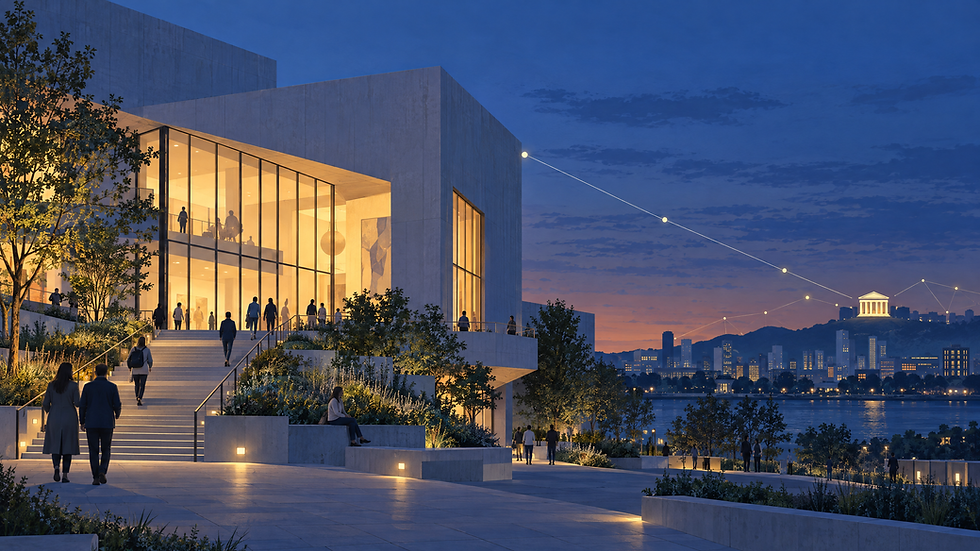
Original editorial illustration; not a documentary photo, artwork reproduction or building rendering.
14 October 2026
A museum leaves its address
On 17 October, Centre Pompidou Francilien – fabrique de l’art in Massy begins the first of three free preview weekends. The building will formally open in spring 2027, but the early programme—walks through raw architectural spaces, collection works, performances, talks and workshops—already rehearses an institution without its conspicuous home.
The Beaubourg building closed its doors on 22 September 2025. Centre Pompidou presents a 2030 return as the aim of a programme addressing façade asbestos, structural corrosion, energy performance and accessibility, while reworking visitor areas, collection displays and the Public Information Library, or Bpi. The closure removes a building whose scale and social mixture were part of its cultural proposition: reader, school group, cinema-goer and museum visitor did not have to occupy separate institutional worlds.
The interim answer is called Constellation. It distributes collection loans, exhibitions, cinema, performance, educational work and research among partner sites in Paris, France and abroad. The metaphor is attractive, but a public institution has to answer for what separation costs. The central question is not whether the Centre can remain busy while Beaubourg is closed; it plainly can. It is whether the public must do more work to assemble it.
The radical building has become a repair problem
Beaubourg is not an interchangeable shell. When Renzo Piano and Richard Rogers’ building opened in 1977, its exposed servicing and circulation made culture look like infrastructure rather than a sealed monument. Its colour-coded exterior made that proposition literal: blue for air, yellow for electricity, green for water and red for pedestrian movement. Fiercely contested at first, it became one of Paris’s defining civic interiors.
The renovation must preserve a structure identified with openness while repairing the systems that made that openness expensive and difficult to maintain. The official record confirms complete asbestos removal, structural treatment, energy optimisation and accessibility as central imperatives. It also frames the project as a rethinking of how collections, creation and the Bpi meet.
No serious cultural argument treats asbestos removal as a dispensable inconvenience. Yet repair does not end the question of public loss. An open letter signed by, among others, Nicolas Bourriaud, Daniel Buren and Catherine Millet opposed a five-year shutdown, arguing that Paris risked weakening a public service while private foundations gained greater prominence. The Centre’s response, reported by The Art Newspaper, was that a ministerial commission found a closed-site approach cheaper, less risky and shorter, and necessary for complete asbestos removal.
The 2030 reopening is a timetable, not a settled outcome. In June 2026, the Cour des comptes put the renovation’s cost at €469 million for 2025–30 and described that estimate as a floor that could rise. It also warned that a long full closure risks losing own-source revenue while operating costs still sustain programming beyond the site. Constellation is therefore more than a curatorial experiment: it is the public-facing continuity required during a costly interval.
Constellation is more than a loan programme
National collections have long lent works elsewhere; a touring exhibition does not by itself remake an institution. Constellation reaches beyond paintings and sculptures on the road. The current programme places projects at the Grand Palais, Panthéon, Musée d’Art Moderne de Paris, Centre Pompidou-Metz and regional venues from Lyon to Toulon, alongside international partnerships.
The operational shift is clearest in activities that disappear from accounts of a museum as an exhibition machine. The Bpi relocated to the Lumière building in Paris’s 12th arrondissement in August 2025, with the same access conditions and a large reading and workshop offer. Cinema and documentary activity moved to mk2 bibliothèque x Centre Pompidou; Studio 13/16 moved to Gaîté Lyrique; Ircam remains by Place Stravinsky.
The Bpi’s free, late-opening presence was not a decorative annex. A student could arrive for a desk, encounter a film programme, pass a gallery, then linger on the piazza without buying a ticket or declaring a disciplinary allegiance. New locations may improve particular services, but they cannot reproduce the accidental adjacency that the old building made routine.
Access has to be measured at ground level
Constellation’s public argument is credible in one respect: it can enable encounters with works and programmes beyond central Paris. Centre Pompidou says its 150,000-work collection makes more than 6,000 loans annually in France and abroad. Regional partnerships can make that national collection less dependent on a single Parisian postal code.
But decentralisation is not automatically democracy. Its measure is mundane and exacting: admission prices, booking systems, late hours, step-free routes, transit connections, clear information and the time needed to travel between sites. The Massy previews are free on 17–18 October, 24–25 October and 31 October–1 November 2026. A free weekend can offer a welcome threshold; it is not yet evidence of a dependable cultural routine.
The distinction bears on people who used Beaubourg without appearing in the usual visitor imaginary: someone working after class in the Bpi, a parent seeking a youth programme, a person who needs reliable accessible facilities, or a Paris resident for whom one central journey was practical and a chain of destinations is not. A network can extend an institution’s geography while fragmenting its ease of use.
Massy and the public life of museum labour
Massy is Constellation’s most consequential experiment because it makes the museum’s backstage visible. The 30,000-square-metre site will include reserves for the 150,000-work collection, conservation and restoration workshops, research facilities, exhibition spaces and public-engagement areas. Its inaugural project, 150,000! La fabrique du musée, will make the making of the museum its subject.
Conservation, acquisition, storage, restoration and transport determine what survives, what can travel, what gets studied and what falls from view. Treating those activities as public knowledge could give visitors a more adequate account of how a collection exists. It may also shift the hierarchy in which the gallery appears as culture’s finished surface and the people who care for works disappear.
The project is developed with the Ministry of Culture, the Île-de-France Region, Essonne, Paris-Saclay, the City of Massy and Université Paris-Saclay. It could become a durable resource in southern Île-de-France rather than a warehouse with occasional audiences. The difference will be found in regular access, local partnerships and whether residents have reason to return after inaugural attention moves on.
What should survive the reopening
By 2030, a repaired Beaubourg may offer safer systems, more accessible spaces and a renewed public interior. Its reopening should not be imagined as a simple restoration. The closure has exposed the extent to which Centre Pompidou is already a composite institution: museum, library, cinema, performance venue, educational platform, research body and lender of a national collection.
The value of Constellation will not be proved by pretending the original concentration of these functions did not matter. It will be proved if the Centre learns from the separation: preserves the Bpi’s public role, keeps meaningful regional relationships after the cranes leave Paris, and makes Massy a place for sustained local use rather than an annex granted periodic animation. A national museum can become a network. The unresolved question is whether it can do so without asking the public to become its logistics department.
Sources and records
1. Centre Pompidou, Centre Pompidou is transforming itself: https://www.centrepompidou.fr/en/centre-pompidou-is-transforming-itself
2. Centre Pompidou, Centre Pompidou Francilien – fabrique de l’art, Massy: https://www.centrepompidou.fr/en/centre-pompidou/regional-action/centre-pompidou-francilien-fabrique-de-lart-in-massy
3. Centre Pompidou, Public Information Library at Lumière: https://www.centrepompidou.fr/en/lieu/bpi
4. Centre Pompidou, Season April–December 2026: https://www.centrepompidou.fr/en/offer-to-professionals/press-area/saison-avril-decembre-2026
5. The Art Newspaper, Centre Pompidou must not close for five years, say French critics and curators: https://www.theartnewspaper.com/2024/06/17/centre-pompidou-must-not-close-for-five-years-say-french-critics-and-curators
6. Cour des comptes, Les grands chantiers patrimoniaux du ministère de la culture, June 2026: https://www.ccomptes.fr/sites/default/files/2026-06/20260616-synthese-Grands-chantiers-patrimoniaux-ministere-de-la-culture.pdf
7. Sortiraparis, The Centre Pompidou Francilien is hosting three free weekends ahead of its grand opening, updated 9 October 2026: https://www.sortiraparis.com/en/what-to-visit-in-paris/exhibit-museum/articles/350795-the-centre-pompidou-francilien-is-hosting-three-free-weekends-ahead-of-its-grand-opening

$50
Product Title
Product Details goes here with the simple product description and more information can be seen by clicking the see more button. Product Details goes here with the simple product description and more information can be seen by clicking the see more button

$50
Product Title
Product Details goes here with the simple product description and more information can be seen by clicking the see more button. Product Details goes here with the simple product description and more information can be seen by clicking the see more button.
$50
Product Title
Product Details goes here with the simple product description and more information can be seen by clicking the see more button. Product Details goes here with the simple product description and more information can be seen by clicking the see more button.

Comments