The Repair Manual Is Not a Metaphor: Otobong Nkanga’s Paris Strata

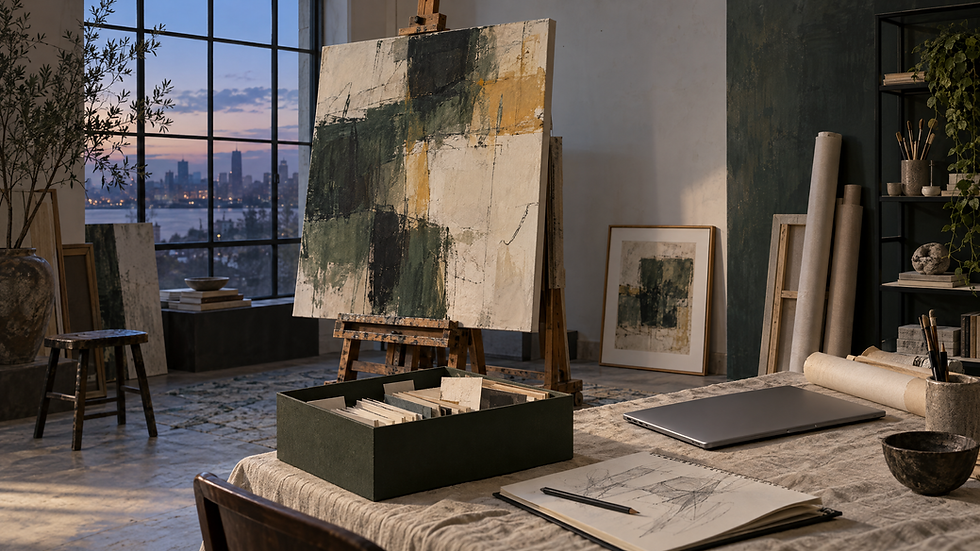
Image disclosure: The cover is an original editorial still-life illustration, not documentary photography, a work of art, an artist portrait or an exhibition view.
THINK PIECE | Source-led cultural profile
Deck: At the Musée d’Art Moderne de Paris, Otobong Nkanga made earth, textile, scent, labour and circulation speak to one another. The result was not a consoling ecology of connectedness, but a harder proposition: care has to be designed, handled and maintained—and it does not erase the mark of extraction.
13 October 2026 | Paris / Lausanne
Scope: This post-exhibition analysis is grounded in museum records, catalogue material and independent criticism. It does not claim firsthand attendance.
A repair manual tells you two things at once: something has failed, and restoration will require a sequence of exact actions. It asks for tools, time, pressure, substitutions and judgment. Otobong Nkanga’s I dreamt of you in colours, the first monographic exhibition of her work in a Paris museum, made that proposition unusually vivid at the Musée d’Art Moderne de Paris. It ran from 10 October 2025 to 22 February 2026 before travelling to the Musée cantonal des Beaux-Arts in Lausanne, where it closed on 23 August. The Paris exhibition’s achievement was to make a practice frequently reduced to “ecological art” read instead as an extended study of maintenance: how bodies, objects, landscapes and institutions hold together, and who pays when they do not. [1] [4]
The museum called its organizing concept “strata.” The term carries the geological sense of layers, but Nkanga uses it as a method: bodies and land are not analogous abstractions; they are systems changed by exchange. Materials circulate, acquire value, cross borders and retain the residue of the labour and violence that moved them. Paris assembled installations, photographs, recent work and a substantial group of drawings—some from the early part of her career and previously unshown—rather than presenting a neat march toward mastery. Certain works were reactivated with elements added for the site. That decision matters. A retrospective normally fixes a career into evidence; reactivation leaves the evidence contingent, still capable of receiving another layer. [1]
An early body, built from earth
The most useful entrance into this structure is not a monumental textile but a small, early photographic work. In Fattening Room (1999), Nkanga appears in a white lace dress with a crinoline skirt, her head bowed in blue light. The image was made while she was studying at the École des Beaux-Arts in Paris and responding to the Ibibio rite of passage of the same name, which she did not herself undergo. For the work, she built a skirt around her body over a month from compacted soil and white clay, collaborated with a fashion designer on a European-style wedding dress, then had photographs taken, cut them apart and recomposed them. [2]
Those are not decorative production details. They establish a vocabulary that the later works enlarge: dress as social instruction, clay as a temporary architecture around the body, and the photograph as a surface that can be cut and reseamed. The process also resists the easy division between “personal” memory and the supposedly impersonal material world. In the exhibition catalogue interview, Nkanga recalls studying mud houses in Ife, made with straw, rock, wood, palm leaves and a mixture of rock and water; the experience helped her think through Fattening Room. [1] A garment can therefore be a landform and a building method, but it remains a garment—with all the expectations about gender, ceremony and appearance that cling to it.
That is why the fashion connection in Nkanga’s work is more rigorous than a borrowed language of adornment. In her practice, shimmer is never innocent finish. Tate’s account of In Pursuit of Bling (2014) points to mica, used in cosmetics for its lustre, as a route from desirable surface to extraction’s ethical, human and material consequences. [5] She does not ask viewers to stop enjoying colour, softness or shine. She asks what has been compressed into their availability. For readers alert to the politics of a mineral make-up pigment, a woven wall work or a meticulously made interior, Nkanga offers something more exacting than a lesson in guilt: aesthetic pleasure is a relay in a supply chain.
Needles, roots, seams
This is where the “manual” in the title becomes literal. In the Paris installation, sharp linear elements repeatedly hold, pierce or suspend things. Apollo’s review describes Contained Measures of Land – The Operation (2008) as severed orange-tree roots bursting through a wall and pierced by large needles. Nearby, Awaiting Pleasures – The Workstation (2003) brought a wooden loom, oversized needles, rope and thread into view. The critic’s decisive observation is that these tools can serve art, industry or violence. [2] Nkanga’s seams do not make damage disappear; they identify where something has been split, and show that joining is an intervention with force behind it.
The same tension scales up in The Weight of Scars (2015), a large tapestry made after visits to abandoned mining sites in northern Namibia. Documentary photographs of the scarred landscape appear within the weave, while phantom limbs pull at its imagery. [2] Tapestry is an especially pointed medium for this work. It converts labour into density and time, but also brings the authority of a grand European decorative form. Nkanga does not simply insert a mining story into an inherited luxury object. The material history of weaving becomes part of the question: whose labour has traditionally made walls eloquent, and what does it mean for a damaged site to enter domestic or museum scale as a sumptuous surface?
The four Unearthed tapestries of 2021 make the argument less terrestrial and more severe. Their submarine worlds move through zones of the sea, where plant matter, mechanical limbs and bodies subjected to the transatlantic slave trade coexist with the pressure of mining and climate change. [2] In the exhibition interview, Nkanga connects the series to deep-sea extraction: what has settled does not necessarily get to rest, when minerals are again sought for energy and profit. [1] Her images do not turn the ocean into a poetic backdrop for catastrophe. They insist that “below” is already an archive and a workplace.
Against repair as consolation
The institutional framing is generous, even hopeful. MAM described natural and relational systems’ “reparative capacity” and a possible future; its emphasis on constellations makes the exhibition a persuasive picture of interdependence. [1] But two independent accounts place useful pressure on that language. Yosola Olorunshola’s Apollo review finds the work beautiful precisely because it refuses to romanticise violent histories: black dots may read as holes, pins, wounds or joints. [2] Hyperallergic, meanwhile, identifies sand, glass beads, wood, braided rope and soap among the exhibition’s materials, and characterises the large tapestries through colonialism’s devastating legacies as well as the fragile ties joining people, land and resources. [3]
Together, these accounts make clear that repair is not the show’s sentimental final scene. It is a contested procedure. A pin can mend or puncture. A thread can connect, bind or pull apart. A carpet can invite the body into a less formal relation with the museum while still being an art object subject to access, care and rules. From Where I Stand (2015), the chromojet-printed carpet acquired by MAM in 2022, was conceived by the artist as a place where visitors might lie down and see both carpet and museum differently, potentially making it a place for conversation. The Paris programme also activated the work in a performance on 10 January 2026. [1] [5] [9] That is a modest but radical redesign of spectatorship: not participation as spectacle, but a changed posture from which to consider an institution and its holdings.
Nkanga’s trajectory gives this question a real institutional scale. Born in Kano in 1974 and based in Antwerp, she trained in Ile-Ife, Paris and Amsterdam; surveys and solo presentations have moved through Chicago, Tate St Ives, the Gropius Bau, Kunsthaus Bregenz, Castello di Rivoli, MoMA and the Nasher Sculpture Center. [1] [6] The Paris project drew from international public and private collections as well as her studio, while MAM’s own collection supplied From Where I Stand. [1] This is not the career of an artist standing outside museums and issuing a purity test. It is the career of someone working inside the routes by which objects, research, capital and institutional attention accumulate.
That proximity sharpens the most serious limit—and the most serious ambition—of Nkanga’s repair language. Carved to Flow, begun for documenta 14 in 2017, turned soap into a distribution system. O8 Black Stone bars were made from oils, butters and other ingredients sourced across the Mediterranean, Middle East and North and West Africa; they were produced in Athens and assembled in Kassel as lattice-like sculptural stocks. Their sale was also a public-space performance: under specified conditions, performers could refuse a transaction. The proceeds were intended to support the Carved to Flow Foundation in Akwa Ibom and a space in Athens. [7] [8] Here “support” is not a museum label pasted onto an object. The project’s own text treats support as a structural, social and economic act: to hold up, provide for and reinforce. [7]
Yet that is an experiment, not an alibi. A foundation sustained by sales of art-adjacent objects remains entangled with the unequal economies of circulation that Nkanga traces. The promise is not that a bar of soap can compensate for extractive trade, or that an exhibition can make a supply chain just. Its value lies in refusing to leave care at the level of imagery. Soap dissolves; a support structure requires continuous administration, people, resources and trust. Frieze described Carved to Flow as a test of a circular economy rather than a completed alternative to exploitative finance. [8] The distinction is important.
Why return to the Paris strata now, after both museum presentations have ended? Because cultural institutions are increasingly fluent in the language of sustainability while still treating materials as display assets and repair as a reassuring theme. Nkanga’s work is harder on that comfort. It requires that we see a bead, a mineral, a carpet, an aromatic wall or a dress not as evidence of a refined sensibility but as a record of handling: extraction, transportation, fashioning, use, contamination, conversation and eventual change. Its pleasure is real, and so is its cost. The repair manual is not a metaphor because the work makes the terms of repair material, procedural and public. It also refuses the fantasy that careful making will leave no scar.
Sources & records
[1]: https://www.mam.paris.fr/en/expositions/exhibitions-otobong-nkanga-0 "Musée d’Art Moderne de Paris: Otobong Nkanga, I dreamt of you in colours"
[2]: https://apollo-magazine.com/otobong-nkanga-artist-musee-d-art-moderne-paris-review/ "Apollo: Otobong Nkanga gets down to fundamentals"
[3]: https://hyperallergic.com/top-10-paris-art-shows-of-2025/ "Hyperallergic: The 10 Best Paris Art Shows of 2025"
[4]: https://www.mcba.ch/en/exhibitions/otobong-nkanga/ "Musée cantonal des Beaux-Arts Lausanne: Otobong Nkanga, I dreamt of you in colours"
[5]: https://www.tate.org.uk/press/press-releases/otobong-nkanga-where-i-stand "Tate: Otobong Nkanga, From Where I Stand"
[6]: https://www.nashersculpturecenter.org/programs-events/nasher-prize/laureates/laureate/id/320 "Nasher Sculpture Center: Otobong Nkanga, 2025 Laureate"
[7]: https://www.carvedtoflow.com/ "Carved to Flow: Project by Otobong Nkanga"
[8]: https://www.frieze.com/article/otobong-nkanga-excavates-material-histories "Frieze: Otobong Nkanga Excavates Material Histories"
[9]: https://www.mam.paris.fr/sites/default/files/documents/en_dp_otobong_nkanga_mam.pdf "Musée d’Art Moderne de Paris: Otobong Nkanga press kit"

$50
Product Title
Product Details goes here with the simple product description and more information can be seen by clicking the see more button. Product Details goes here with the simple product description and more information can be seen by clicking the see more button

$50
Product Title
Product Details goes here with the simple product description and more information can be seen by clicking the see more button. Product Details goes here with the simple product description and more information can be seen by clicking the see more button.
$50
Product Title
Product Details goes here with the simple product description and more information can be seen by clicking the see more button. Product Details goes here with the simple product description and more information can be seen by clicking the see more button.


Comments