The Spaghetti House Is a Public Institution: Mohammed Z. Rahman’s Small-Scale Worlds

Reported Profile | Art, Care and Domestic Life
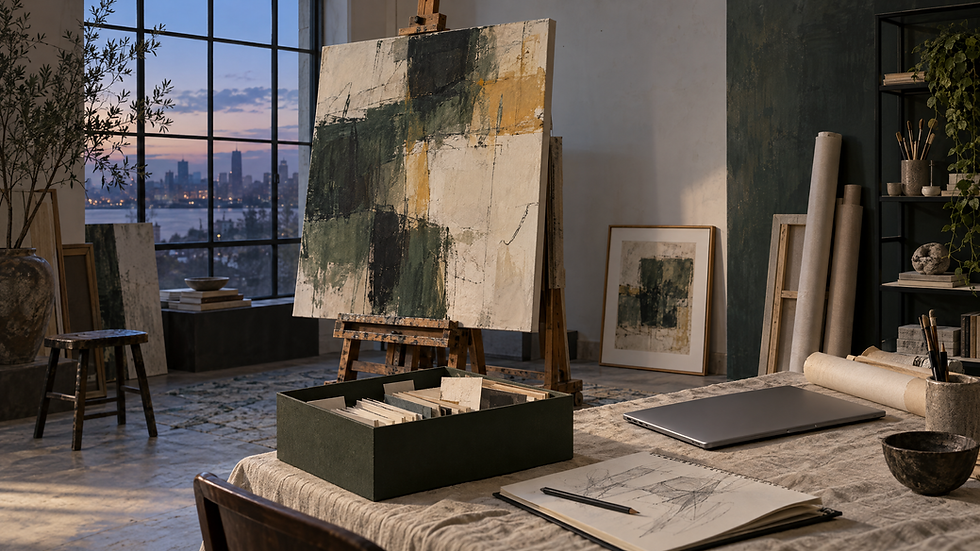
Image disclosure: This is an original editorial illustration, not a documentary photograph, artwork reproduction or exhibition view.
At Tate Britain, the British-Bengali artist makes a case for domestic invention—not as a private refuge or a decorative motif, but as a place where public history is already being made.
This source-led profile draws on institutional records and published reporting. It does not claim firsthand attendance at the exhibition.
At the entrance to Mohammed Z. Rahman’s Never the Same at Tate Britain stands a house made of spaghetti. This is not a metaphor added after the fact by a curator looking for a light way into difficult subjects. The Spaghetti House (2024) began with a story Rahman devised with his six-year-old niece; Tate has made the painting the threshold of the first of two theatrical “acts” in its current Art Now presentation. The premise is comic and precise: a home whose roof is made of pasta, whose windows disclose small domestic scenes, and whose skipping rope becomes a noodle in the account published by Hyphen. [1] [2]
It is also now a Tate work. Acquired alongside The Lovers (2024) through the Frieze Tate Fund, the painting has travelled an unusually charged route: from a child’s conjectural architecture to a national collection, then back into a display about home, play and joy. [3] That route supplies the real subject of this exhibition. Rahman’s small-scale worlds ask what changes when the modest technologies of ordinary life—shared food, a matchbox, a wooden crate, a bedroom table, a remembered house—enter the museum. The answer is neither that they become grander, nor that they remain untouched. Rather, the works make the conversion visible and uneasy.
Tate’s framing is admirably clear. Never the Same, on view through 8 November, consists of a new body of paintings staged in two theatrical “acts,” each housed in a timber pavilion inspired by Bengali wedding canopies and keyed to a Tate collection work. [1] [7] Act One takes The Spaghetti House as its entry point. Act Two begins with The Lovers, a painting of six closely embracing figures that may be standing, lying down or dancing; its title and premise draw on the tarot card. Tate describes subsequent paintings of sorrow and celebration, including a weeping figure amid ex-lovers’ belongings and a shipping crate remade as a box of chocolates. [1] The programme is called Art Now, Tate Britain’s ongoing series for new work by emerging artists. That designation is accurate but incomplete. The interest here is not an abstract promise of “emergence”; it is the quickening institutional life of a practice determined to keep the ordinary legible on its own terms.
A house as a social form
Rahman’s houses are neither nostalgic stage sets nor sociological diagrams. Their compactness matters. In an independent review of the 2025 Peer exhibition Remember to Live, Sabine Casparie described visitors leaning close to inspect its miniatures, including cross-sections of homes in which seamstresses, pets, food, washing and neighbours occupy distinct but contiguous zones. [4] The form provides an ethic of attention: the viewer must adjust their body to the work rather than expecting the work to command a room.
That scale also refuses the false choice between private scene and public matter. At Peer, Rahman’s permanent mural At Home was developed with the gallery’s Ambassadors, a group of 17- to 25-year-olds from Hackney and Tower Hamlets. Its imagined cross-section of a residential building addressed how home might offer shelter and hope while remaining pressured by racism, housing costs and instability. Frieze reported the commission as an extension of Rahman’s conviction that the everyday is where politics take effect. [3] The apartment is not deployed as a symbol of some singular community. It is a working structure: a place of cooking, care, argument, labour and improvised self-fashioning.
That is why The Spaghetti House carries more than whimsy. In Hyphen, Rahman connected the work to the urgency of taking children’s dreams seriously amid the reported killing of children in Gaza. The article also identifies the three Spaghetti Rooms in the Tate display as expansions of that invented environment, informed by colourful shared houses in Rahman’s twenties and the East London homes that opened for gatherings at Eid. [2] Those are specific social arrangements, not an atmospheric idea of domestic warmth. Pasta is edible, cheap, unruly and briefly architectural; it lets play become a model for the way a household builds a world out of what is at hand.
The distinction is crucial because a museum can too easily aestheticise scarcity. Rahman’s works instead keep material conditions in view. Born in London in 1997 and based there, the British-Bengali artist studied social anthropology at SOAS before finding its established methods inadequate for the layered positions it attempted to describe. La Biennale di Venezia’s 2026 account places that encounter at the origin of a practice extending across painting, sculpture, drawing and zines, where folk tales, historical events and dreamscapes meet. [5] Rahman’s quarrel was not with knowledge itself, but with the removal of knowledge from the people and places under discussion. In Hyphen, he described finding ethnographies of East London Bangladeshi communities inaccessible in both their paywalls and their academic English. [2]
Painting becomes a counter-archive here: not a transparent correction to official histories, but a way to allow memory, family lore and the impossible to keep company. The imaginary house is convincing precisely because it does not pretend to documentation. Its visual logic can accommodate a noodle rope, a domestic window and an implausible roof without sorting them into the real and the merely fanciful. That freedom is political in a modest, durable sense. It makes room for an account of experience that is not obliged to arrive in the language of proof.
Matchboxes, crates and the question of use
Rahman repeatedly chooses supports that retain a prior public life. At Tate, Hyphen reports, miniature paintings of chillies, plants, bread and a half-full glass occupy matchboxes arranged along a shelf and wall; elsewhere, a shipping crate becomes a chocolate box. [2] At Venice, where Rolling Heart remains on view in the Central Pavilion through 22 November, the operational logic is still clearer. The installation puts recent works in an open pine framework, with paintings facing in and out so that images and notes can be seen on their reverses. Shipping crates act as painting surfaces and as seating. [5]
The crux is not that a crate has been magically redeemed as art. It is that Rahman declines to let it shed its capacity for use. At Venice, Memento Vivere makes the double register explicit: a crate painted as a condom packet celebrates workers, carers, lovers and agitators of the early AIDS epidemic. [5] A crate holds, transports, supports weight and, in Venice, offers a visitor somewhere to sit. A matchbox is an almost comically limited surface, but it also contains the possibility of flame. In the Peer show, Safe Landing consisted of 48 acrylic-painted matchboxes set across ink-stained wooden shelves; the review records objects and animals within them, as well as the artist’s association of shards of glass with anti-migrant violence. [4] The miniature is therefore not innocent. It makes concentration possible while carrying danger at its edge.
This practical intelligence is inseparable from Rahman’s account of making. His mother worked as a seamstress after arriving in Britain in the 1980s, he told Hyphen, and that experience shaped his refusal to rank the skill of clothing production below the category of fine art. [2] Whitechapel Gallery’s 2025 Hearthside, made in partnership with Oitij-jo, developed the same proposition through food knowledge, supply chains and the dinner table. It brought paint, sculpture and installation to questions of hospitality and care, rather than treating cuisine as a picturesque ethnic signifier. [6]
The analogy between a seam, a shelf and a painted surface should not be forced; these are different kinds of labour. But Rahman is persuasive because he does not use craft as a reassuring moral gloss. A painted box remains a box. A meal requires ingredients, labour, access and guests. A home can be a site of welcome and pressure at once. Casparie’s review supplies an important restraint: it finds the work most compelling in its imaginative, intimate scenes rather than in its larger sociopolitical stories. [4] The practice’s colours—reported as saturated maroons, greens, indigos and ochres in the Peer review—are not a shortcut to cheerfulness. They are part of an insistence that attention, pleasure and difficulty are allowed to coexist. [4]
What a museum can hold
There is a productive contradiction at the centre of Never the Same. Rahman has said that he wants to dispel the mythology surrounding the artist and foreground the fact that people make art continually; Hyphen reports that much of the Tate work was made on a bedroom or kitchen table. [2] Yet the exhibition is staged at Tate Britain, supported by named foundations and supporters, and organised around two paintings newly held by the national collection. The institution is not incidental to the argument. It is the pressure that gives it shape.
The danger would be to read this as a clean story of elevation: overlooked domestic creativity arrives, finally, at the museum and is certified. Rahman’s own trajectory makes that reading too thin. Before Tate, there were zines and postcard prints sold at house parties; a 2022 Brent Biennial commission after curator Eliel Jones encountered the work online; the 2025 Peer exhibition, Rahman’s first solo presentation in a public gallery; the Whitechapel presentation; and the public mural in Hoxton. [2] [3] [8] These are not simply rungs on a ladder. They are different formats of address, each with its own audience, permissions and limits.
Tate’s two-act structure acknowledges this without dissolving it. By making collection paintings the entrance points, the display admits the museum’s role in authorising what may be seen. But the paintings’ internal economies keep pulling attention outward: to a niece’s story, a shared flat, a mother’s skill, a local table, a screen of tiny objects that asks a person to lean close. A serious encounter with this work should not end in gratitude that such material has been admitted to the canon. It should ask what forms of description, care and access the canon still cannot provide.
That question matters now because Rahman’s practice arrives in a London saturated with exhibitions about archives, identity and repair, yet it does not begin with the archive’s prestige. It begins with ordinary people making images, stories and arrangements for one another. At its best, Never the Same proposes a more demanding version of public art: not work that speaks for everyone from above, but work that shows how a private table, a matchbox or a made-up house is already connected to the public world. The Spaghetti House is a public institution not because Tate owns it, but because it gives common life a form that can be entered, questioned and remade.
Sources & records
1. https://www.tate.org.uk/whats-on/tate-britain/art-now-mohammed-z-rahman "Tate Britain: Art Now, Mohammed Z Rahman"
2. https://hyphenonline.com/2026/07/15/mohammed-z-rahman-artist-never-the-same-exhibition-tate-britain/ "Hyphen: Mohammed Z Rahman, ‘I want to do away with this mythology around being an artist’"
3. https://www.frieze.com/article/life-is-sweet-mohammed-z-rahman-frieze-week-magazine-london-2025 "Frieze: Mohammed Z. Rahman, Life Is Sweet"
4. https://www.studiointernational.com/index.php/mohammed-z-rahman-remember-to-live-review-peer-london "Studio International: Mohammed Z Rahman, Remember to Live"
5. https://www.labiennale.org/en/art/2026/mohammed-z-rahman "La Biennale di Venezia: Mohammed Z. Rahman"
6. https://www.whitechapelgallery.org/exhibitions/mohammed-z-rahman-hearthside/ "Whitechapel Gallery: Mohammed Z. Rahman, Hearthside"
7. https://www.tate.org.uk/press/press-releases/art-now-mohammed-z-rahman "Tate: Art Now, Mohammed Z Rahman — press release"
8. https://peeruk.org/programme/mohammed-z-rahman-remember-to-live "Peer: Mohammed Z. Rahman, Remember to Live"

$50
Product Title
Product Details goes here with the simple product description and more information can be seen by clicking the see more button. Product Details goes here with the simple product description and more information can be seen by clicking the see more button

$50
Product Title
Product Details goes here with the simple product description and more information can be seen by clicking the see more button. Product Details goes here with the simple product description and more information can be seen by clicking the see more button.
$50
Product Title
Product Details goes here with the simple product description and more information can be seen by clicking the see more button. Product Details goes here with the simple product description and more information can be seen by clicking the see more button.

Comments