Luciano Fabro’s Habitats Ask a 2026 Question: Can Art Teach Us to Inhabit Space Together?

Reported Explainer | Visual-Culture Analysis
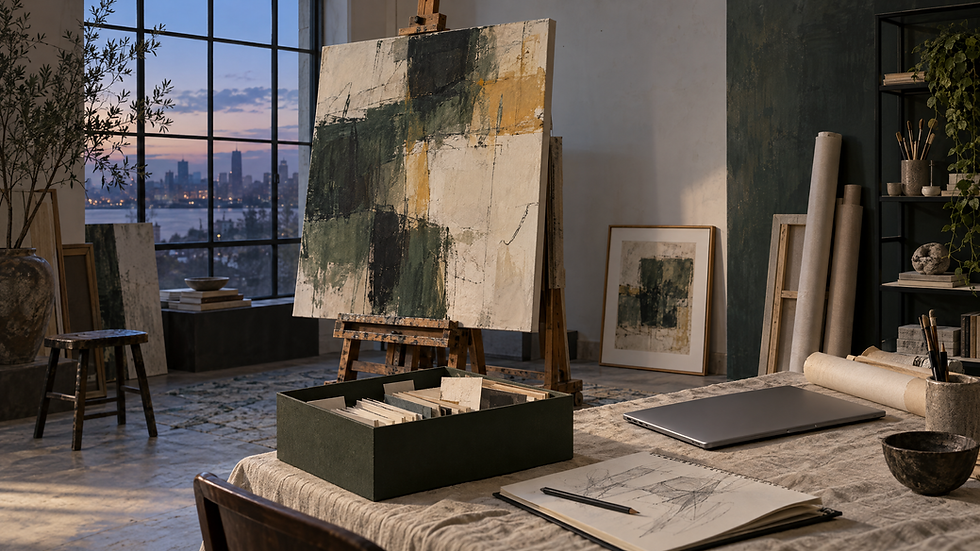
Image disclosure: This is an original editorial illustration, not a documentary photograph, artwork reproduction or exhibition view.
At Pirelli HangarBicocca, a posthumous reconstruction project makes shared space less a slogan than a set of material, bodily, and institutional choices.
This is a records-based explainer, not an exhibition review. It draws on the exhibition’s published guide, checklist, visitor information, institutional records, and independent criticism; it makes no claim of firsthand attendance.
Date: October 13, 2026
A retrospective arrives with a live question
Luciano Fabro’s Abitare lo spazio. Inhabiting Space opened at Pirelli HangarBicocca in Milan on October 8 and runs through February 21, 2027. The museum calls it the first Italian institutional retrospective of the Turin-born, Milan-based artist since his death in 2007. Around 50 sculptures and installations trace a career that moved from mirrored and glass works of the 1960s to large, provisional architectural environments. Fiammetta Griccioli, Roberta Tenconi, and artistic director Vicente Todolí curated the project with Silvia Fabro and the Archivio Luciano e Carla Fabro. [1]
The show arrives within HangarBicocca’s 2026–27 program, which frames art and architecture as a dialogue around collective knowledge and accessibility. Fabro called certain paper-and-wood structures “Habitats,” refusing the fiction that space merely receives art after the real work is done. The art historian Sharon Hecker identifies the Habitats as collectively inhabitable, in contrast to In cubo, Fabro’s one-person enclosure. [2] [9]
The 2026 question is narrower than the hopeful language of “community” often attached to immersive art. Can an exhibition clarify who moves first, waits, enters, is protected from damage, or receives help making sense of a room? Fabro’s work cannot answer Milan’s housing or access crises. It can make rules of togetherness visible.
Milan is not a merely convenient backdrop for that question. Fabro moved there in 1959, helped establish Casa degli Artisti with Hidetoshi Nagasawa and Jole De Sanna in 1978, and taught at the Brera Academy from 1983 to 2002. The exhibition guide characterizes Casa degli Artisti as a site of intergenerational exchange and describes Fabro’s teaching as a practice of active engagement. These are modest but meaningful coordinates: a sculptor concerned with the measure of a room also spent decades within institutions where artistic knowledge passed from one body to another. [1] [3]
A habitat is a structure, not a vague metaphor
The central reconstruction is Habitat (di Rotterdam), first made for Fabro’s 1981 retrospective at Museum Boijmans Van Beuningen. It has paper-clad, free-standing walls and corridors governed by geometry and built to hold a group of works. Paper routes sit among Fabro’s glass, metal, and marble objects, complicating the shorthand that treats Arte Povera as a style of humble matter alone. For Milan, the Archivio, Boijmans, and Rotterdam’s city archive supplied material and records; some works were substituted for public access, availability, and conservation. [1] [3]
The historical form is worth pausing over. In Rotterdam, the Habitat occupied roughly 1,100 square metres and displayed more than 20 works through five asymmetric corridors, their walls covered in folded paper. Fabro’s plan drew on perspective and the golden ratio, yet it was not an exercise in geometric purity: the guide calls it an autonomous environment, a temporary architecture in which works acquired meaning through their neighbours and the visitor’s changing position. That mixture of fragile surface, rigorous plan, and bodily drift gives the word “habitat” its force. [3]
Those qualifications matter. A reconstruction decides which relations—dimensions, routes, materials, artworks, instructions—must be carried forward. The checklist credits Silvia Fabro and the Archivio with rebuilding the Rotterdam Habitat, other environments, and exhibition copies. What looks provisional is, in fact, a dense exercise in historical judgment. [4]
Fabro’s proposal was more exacting than “immersive” suggests. In cubo is calibrated to bodies and appears here in five sizes. Allestimento teatrale, a mirrored cube, admits one visitor at a time; on weekends, an actor reads Fabro’s texts inside it. These works make thresholds, proportions, solitude, and observation central. [3]
This is one reason the category of Arte Povera needs careful handling. Fabro participated in the first Arte Povera exhibition in 1967, sharing its insistence on direct material experience, but the guide stresses his sustained traffic with art history, Renaissance perspective, Baroque composition, and a wide register of materials—from paper and silk to marble, bronze, glass, and gold. His work does not oppose the handmade to the cultivated, or the rough to the precious. It places those distinctions under pressure. In the Habitats, a seemingly modest wall of paper can perform the structural work of architecture; a marble object can be made to feel newly contingent because its meaning shifts with every turn in a corridor. [3]
The institution sets the terms of encounter
HangarBicocca is not a neutral shell. It is a non-profit foundation conceived and supported by Pirelli, in a former locomotive factory; the Fabro show occupies the Navate within its 15,000-square-metre site. Pirelli names the foundation part of its corporate cultural activity. That does not establish influence on any curatorial decision, but it matters when considering a publicly oriented art space. The industrial hall gives Fabro’s light paper partitions a charged counterpoint: monumental volume is met not with another monument but with an architecture of adjustment. [5] [6]
The program’s mechanics are part of the story. Admission is free, but online reservations receive time-slot priority and members priority without a reservation. The museum says its spaces have no architectural barriers, offers wheelchairs and folding chairs, and directs visitors to exhibition-specific rules. Gallery mediators are present; the guide lists a November lecture by Margit Rowell, a December conversation with Liliana Moro and Gianni Caravaggio, a January lecture by Andrea Viliani, and a February performance. [3] [7]
Inside the exhibition, those terms become literal. Allestimento teatrale is limited to one visitor at a time, while Sala Pentagonale admits two; there, a visitor may hold Il pupo only with gloves provided by cultural mediators. Solitude, supervised touch, and shared looking are not just themes: they are part of the show’s operating grammar. [3]
These are the conditions under which interpretation can become shared rather than private expertise. Yet free admission is not frictionless access. Timed priority, opening hours, mobility needs, staff instructions, and the confidence to ask questions shape who can remain with difficult work. The foundation’s rules also prohibit touching unless staff permits it. [7]
For culturally mobile audiences, there is a temptation to read a former industrial hangar as a ready-made sign of seriousness: scale, exposed history, the promise that art has escaped the domestic museum. Fabro’s paper architectures frustrate that easy grandeur. They introduce intervals, detours, and scaled encounters into the Navate rather than simply filling it. The social question follows form. Does the institution’s large volume produce a public, or does a public emerge only when the route through that volume is intelligible, hospitable, and open to different ways of looking? The documents cannot answer this on behalf of visitors; they give the question a specific physical ground. [3] [5]
The productive tension is between openness and care
Two independent critical accounts are useful precisely because they do not make the same claim. In 1988, Germano Celant emphasized the Habitats’ sensuous, material, and perceptual capacity to generate multiple meanings. In 2018, Hecker foregrounded bodily encounter and possible collective inhabitation. Celant attends to a field of shifting appearances; Hecker brings the viewer’s body and the possibility of a shared one into focus. Together, they describe a complex spatial practice, not an automatic engine of solidarity. [2] [8]
A space can invite bodily awareness while requiring queues, supervision, conservation limits, and distinct versions for distinct bodies. The Rotterdam changes make that conflict legible: a work built to contest the museum wall must meet current museum standards. Protecting fragile paper, glass, and other visitors is part of collective use. A museum should name those limits plainly.
The Archivio’s role is therefore more than an authorship credit. Posthumous installation turns archive work into public mediation: a rebuilt route may preserve artistic thinking, but it also selects the version a public meets. The guide discloses substitutions and reconstructions. That candour is important in an exhibition whose decisive medium is relation rather than a fixed object. Readers can see whether talks and mediators extend it into conversation.
There is a productive ethical restraint in that position. It would be easy to present the Habitats as an antique prophecy of today’s participatory museum, or to conscript them into a familiar story in which art dissolves the line between spectator and maker. Neither the documentary record nor the works’ rules support that simplification. Fabro’s structures stage adjacency without promising agreement. They make a viewer conscious of being measured, reflected, isolated, or placed beside another person. That is less consoling than a rhetoric of belonging, and more useful. It preserves the possibility that shared space is not unanimity but the ongoing negotiation of proximity.
What to watch before February
The practical test is modest. Notice how the show handles waiting, seating, body size, routes, explanation, and the difference between looking at a room and moving through one. Ask whether a “shared” work allows disagreement, silence, and different tempos—not merely participation. Before February, readers can also follow the scheduled program and ask whether its conversations make the reconstruction’s alterations, conditions, and afterlives legible rather than incidental. [3]
Fabro’s achievement, in this documentary record, is to make space an active part of sculpture. Its present value is a sharper proposition: living together involves form, maintenance, permission, and revision. Museums can stage that lesson only when their own structures are made as visible as the art.
Sources & records
1. https://pirellihangarbicocca.org/en/exhibition/luciano-fabro/ "Pirelli HangarBicocca: Luciano Fabro—Abitare lo spazio. Inhabiting Space"
2. https://brooklynrail.org/2018/09/criticspage/Why-Luciano-Fabro-Today/ "Sharon Hecker, Why Luciano Fabro Today?"
3. https://web-assets-hangarbicocca.pirelli.com/wp-content/uploads/2026/10/Exhibition-guide-Luciano-Fabro.pdf "Pirelli HangarBicocca: Luciano Fabro—Inhabiting Space exhibition guide"
4. https://web-assets-hangarbicocca.pirelli.com/wp-content/uploads/2026/10/Map-and-list-of-the-works-Luciano-Fabro.pdf "Pirelli HangarBicocca: Luciano Fabro—Map and list of works"
5. https://pirellihangarbicocca.org/en/pirelli-hangarbicocca/ "Pirelli HangarBicocca: Institutional profile"
6. https://corporate.pirelli.com/corporate/en-ww/aboutus/our-commitment-in-art "Pirelli: Our commitment in art"
7. https://pirellihangarbicocca.org/en/useful-information/ "Pirelli HangarBicocca: Visitor information"
8. https://www.artforum.com/features/luciano-fabro-the-image-that-isnt-there-206116/ "Germano Celant, Luciano Fabro: The Image That Isn't There"
9. https://www.e-flux.com/announcements/6784103/exhibition-program-2026-27 "e-flux: Pirelli HangarBicocca exhibition program 2026–27"

$50
Product Title
Product Details goes here with the simple product description and more information can be seen by clicking the see more button. Product Details goes here with the simple product description and more information can be seen by clicking the see more button

$50
Product Title
Product Details goes here with the simple product description and more information can be seen by clicking the see more button. Product Details goes here with the simple product description and more information can be seen by clicking the see more button.
$50
Product Title
Product Details goes here with the simple product description and more information can be seen by clicking the see more button. Product Details goes here with the simple product description and more information can be seen by clicking the see more button.


Comments