A House Without a House: Kelly Akashi’s Glass-Brick Memorial at the Whitney

Reported Profile | Art, Memory and Material
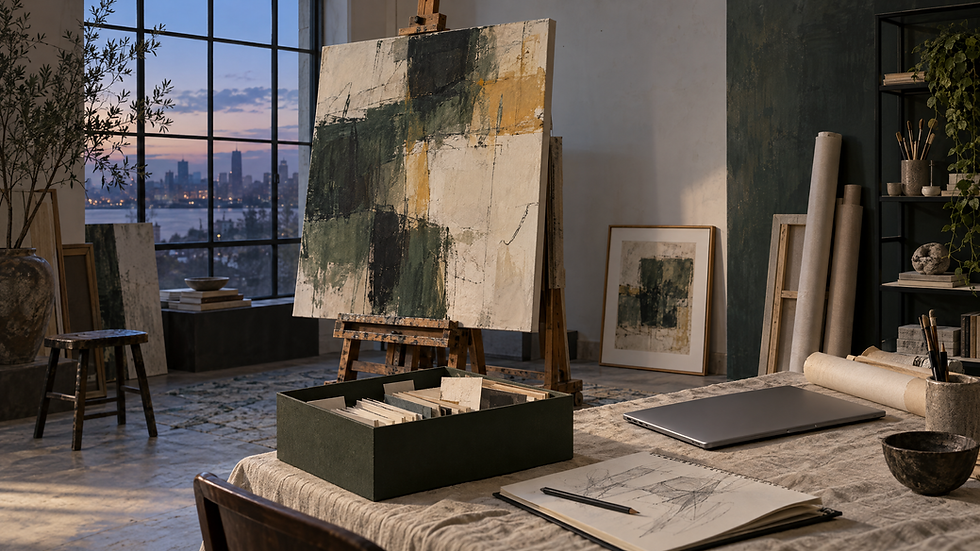
Image disclosure: This is an original editorial illustration, not a documentary photograph, artwork reproduction or exhibition view.
On the museum terrace, a rebuilt chimney became less a monument to recovery than a precise argument about the forms that memory can—and cannot—take.
This source-led postscript draws on published museum records, independent reporting, and installation documentation. The author did not attend the Whitney presentation or visit Akashi’s Altadena property.
A chimney is not a home
A chimney is architecture’s most stubborn fragment. It persists after a house has gone because it is a core built to bear heat, weight, weather and the force of rising air. But it is not a dwelling. It cannot hold a table, the practical clutter of a studio, or the routines that give rooms their human use. That distinction makes _Monument (Altadena)_ (2026), Kelly Akashi’s glass-brick reconstruction of the chimney and walkway left after the Eaton Fire, unusually exact. It did not offer the consolations of an intact house, and it did not pretend that an artwork could return one.
The work anchored Akashi’s Hyundai Terrace Commission at the Whitney Museum of American Art, presented from March 8 through August 23 as part of the 2026 Biennial. On the museum’s fifth-floor outdoor gallery, the Los Angeles artist’s project also included a weathering-steel relief, five works on paper and an outdoor-screen animation. The institutional language described the chimney and pathway as both reconstruction and memorial; it said Akashi worked with a mason to rebuild them in luminous cast glass brick after the January 2025 fire destroyed her home and studio, leaving the chimney standing. [1] [2]
The particularity matters. The Eaton Fire was not a metaphor before it became material for art. CAL FIRE records it as a 14,021-acre Los Angeles County fire that began on January 7, 2025; the current assessment lists 9,419 structures destroyed and 19 confirmed civilian fatalities. [3] In the New York Times, Travis Diehl situated Akashi among the many people who lost houses, reporting that she left with her cat and a few keepsakes while fire consumed her block early the next morning. He also gave the museum work a useful, unromantic measure: a 13-foot chimney and walkway in clear glass brick. [4]
That scale belongs to public sculpture, but the form rejects public sculpture’s usual rhetoric of permanence. A chimney cast in glass is a contradiction with very little ornament around it. It has weight and joins, yet it admits light; it recalls masonry while surrendering the privacy and insulation of a wall. The 821 hand-cast bricks of the chimney and 538-brick walkway were fabricated and assembled in Akashi’s studio, according to Dezeen. Akashi told the magazine that solid glass let her rebuild through “a different material language, where weight and fragility coexist.” [5] That is not a decorative flourish. Glass changes the proposition of rebuilding from replacement to translation.
The long practice behind the emergency
It would be too easy to treat this as an artist discovering loss through catastrophe. Akashi had already spent more than a decade making sculpture out of transformations that retain evidence of their previous states: hand-blown glass, wax, bronze, stones, rope, photographs, body casts, hair. Her 2022–24 survey, Kelly Akashi: Formations, was the first major exhibition and catalogue of the work; it traveled from the San José Museum of Art to the Frye Art Museum and the Museum of Contemporary Art San Diego. [6] The point of recalling that itinerary is not résumé building. It establishes that her present use of glass belongs to a practiced syntax, rather than being an expedient way to render tragedy beautiful.
Akashi initially trained in analog photography, and the photographic logic remains close to her casting. In an interview with Artforum, she described bronze casting as a passage from an original subject through a negative mold to another positive, often using molds only once. She connected the process to a desire for “the least amount of translation between subject and object,” while valuing the glitches that result when material refuses flawless reproduction. [7] The answer clarifies why a reconstructed chimney is not a replica in the souvenir sense. It is a second object that carries a different record: the initial home, the fire’s subtraction, labor in glass, and a location 3,000 miles away on the edge of Manhattan.
The history that courses through this practice is also more layered than a generalized language of ancestry. In Formations, Akashi photographed the trees at Poston, Arizona, where her father and his family were incarcerated during the Second World War. She later cast fallen branches from that site in bronze. [7] A 2022 Los Angeles Times profile recorded her account of returning there during the pandemic, and of the trees likely planted by incarcerated Japanese Americans. It also documented a distinct kind of apprenticeship: Akashi learned candle making from her mother and encountered glassblowing through demonstrations, knowledge that moves by watching hands work rather than through an artist’s statement. [8]
This is why the Whitney work’s single phrase, “what remains,” needs to stay concrete. Remains can be a chimney; branches; negatives and prints; a bodily imprint; a scanned pattern; a procedure passed along. They are not, in Akashi’s work, automatically evidence of triumph. At Poston, the surviving trees make duration visible without repairing an incarceration. At Altadena, a standing chimney does not settle the losses around it. The past survives as matter with a stubbornly incomplete address.
The doily, the scan, the steel
The commission’s most intellectually pointed counterweight to the chimney was _Inheritance (Distressed)_ (2026). Akashi drew it from her grandmother’s doilies, rescued from a family garage sale and later lost in the fire. Pre-fire scans of the textile informed a Cor-Ten, or weathering-steel, relief. [2] A pattern associated with the domestic labor of making and keeping becomes a perforated metal surface: an image that has survived not as heirloom fabric but as data, enlargement, cutting, oxidation.
That conversion has a long prehistory in Akashi’s work. A 2021 piece titled _Inheritance_ joined a cast-lead-crystal hand, a ring from her grandmother, and stone from Poston. [6] The earlier construction gave inheritance literal components, each with a different duration and degree of touch. The Whitney relief makes the problem harder. The doily is absent, and the scan must do some of the work of touch. The museum foregrounded Cor-Ten’s association with Minimalism and its coding as masculine; that framing is productive only if it does not make domestic needlework into a soft corrective for an art-historical hard edge. [2] Akashi’s stronger move is to let both things remain difficult: the decorative lattice and the industrial plate, familial care and the stubborn fact that a fire has converted an original into an afterimage.
Her related _Imprints_ paper works extended that process of transfer. A 2026 essay for the FLAG Art Foundation states that the enlarged doily patterns were embossed and flocked with book ash salvaged from the site. [9] It is a potentially perilous gesture—ash is easily turned into a scenic sign of destruction—but the technique keeps the source specific. The work does not use “fire” as atmosphere. It asks what a mark can carry when its original textile has no material future.
What the terrace can hold
The most compelling friction in Monument (Altadena) comes from its location. A terrace is already a threshold: outside, but staged; exposed to weather, but tethered to an institution. The Whitney’s commission is designed to make art operate against the city and built environment, and Akashi used that setting to bring a fragment of an Altadena house into visual contact with New York. [2] This is not an equivalence between the two places. It is a deliberate mismatch. A house’s remaining flue has been lifted from a burned neighborhood into a museum platform maintained for public encounter.
Independent accounts sharpened the difference in emphasis. The Whitney named a “site of witness” and a meditation on survival. [2] Dezeen retained the formal problem: the chimney’s familiar outline is unsettled by an unfamiliar solid-glass material, and Akashi acknowledged that a rebuilt neighborhood “can never be the same.” [5] Field Set, a two-day Los Angeles Nomadic Division project at the former home and studio, gave that distance a later, local counterpoint: Akashi’s sculptural interventions and replanted garden shared the site with Phil Peters’s three-hour soundscape made from recordings of demolition and nearby rebuilding. [11] [12] Sampson Ohringer, writing in Artillery after visiting that project, called the museum chimney “ghostly, present but transparent.” He contrasted it with the cracked original that still stood in Altadena, and noted how the Meatpacking District’s brick buildings read through the glass. [10]
That last observation makes a necessary limit visible. Transparency can be ethically alert—it refuses the fantasy that the rebuilt object is whole—but it can also make catastrophe exquisitely legible for a museum audience. The relocated chimney asks to be looked through, and therefore risks turning a neighborhood’s emergency into a view. Akashi does not erase that risk; she gives it a form. The walkway’s uninhabitability is crucial. It is not an invitation to imagine oneself home. It is a path whose material transparency makes the distance between subject and viewer, Altadena and the Whitney, insistently apparent.
This is also where the title _Monument (Altadena)_ earns its restraint. Traditional monuments announce endurance through mass, legibility and civic permanence. Akashi’s work claims none of those without qualification. The work was a temporary installation; the fire’s recovery is longer than its run, and the destruction it answers included neither a single household nor a single kind of loss. [1] [3] Its memorial force lies in holding apart what is often collapsed in cultural coverage of disaster: reconstruction is labor, a fragment can be charged, and neither converts bereavement into resolution.
Akashi’s stated formulation for the project is that remembrance is constructed “through care and persistence.” [2] That is a bracing claim precisely because construction is not restitution. Brick by brick, the sculpture describes a house without offering one back. In a season when public art is often asked to supply an image of resilience on demand, this may be its most serious achievement. It makes a usefully inadequate structure: clear enough to carry light, solid enough to stand, and too incomplete to mistake for repair.
Sources & records
1. https://whitney.org/exhibitions/kelly-akashi "Whitney Museum of American Art: Hyundai Terrace Commission: Kelly Akashi"
2. https://whitneymedia.org/assets/generic_file/5077/HTC_B26_DRAFT.pdf "Whitney Museum of American Art: Hyundai Terrace Commission: Kelly Akashi press release"
3. https://www.fire.ca.gov/incidents/2025/1/7/eaton-fire "CAL FIRE: Eaton Fire incident record"
4. https://www.nytimes.com/2026/02/24/arts/design/kelly-akashi-artist-wildfires.html "The New York Times: A Chimney in Search of a Home Lands 3,000 Miles Away"
5. https://www.dezeen.com/2026/04/03/kelly-akashi-glass-brick-chimney-whitney-new-york/ "Dezeen: Kelly Akashi creates glass chimney as memorial to Los Angeles wildfire losses"
6. https://sjmusart.org/exhibition/kelly-akashi-formations "San José Museum of Art: Kelly Akashi: Formations"
7. https://www.artforum.com/columns/on-eternity-internment-and-the-memory-of-touch-252170/ "Artforum: Kelly Akashi—On eternity, internment, and the memory of touch"
8. https://www.latimes.com/entertainment-arts/story/2022-12-30/kelly-akashi-la-artist "Los Angeles Times: How L.A. artist Kelly Akashi’s work evokes tangled feelings about impermanence"
9. https://www.flagartfoundation.org/spotlight-kellyakashi "FLAG Art Foundation: Spotlight: Kelly Akashi"
10. https://artillerymag.com/kelly-akashi-phil-peters-la-nomadic-division/ "Artillery: Kelly Akashi & Phil Peters"
11. https://www.nomadicdivision.org/journal/kelly-akashi-recommendations-altadena "Los Angeles Nomadic Division: Kelly Akashi's Recommendations in Altadena (Field Set details)"
12. https://www.theartnewspaper.com/2026/05/26/kelly-akashi-performance-altadena-los-angeles-wildfires "The Art Newspaper: Kelly Akashi and friends celebrate Altadena's resilience after Los Angeles wildfires"

$50
Product Title
Product Details goes here with the simple product description and more information can be seen by clicking the see more button. Product Details goes here with the simple product description and more information can be seen by clicking the see more button

$50
Product Title
Product Details goes here with the simple product description and more information can be seen by clicking the see more button. Product Details goes here with the simple product description and more information can be seen by clicking the see more button.
$50
Product Title
Product Details goes here with the simple product description and more information can be seen by clicking the see more button. Product Details goes here with the simple product description and more information can be seen by clicking the see more button.

Comments