The Prize Room as a Time Machine: Josèfa Ntjam at MAM Paris

News Analysis | Contemporary Art and Museums
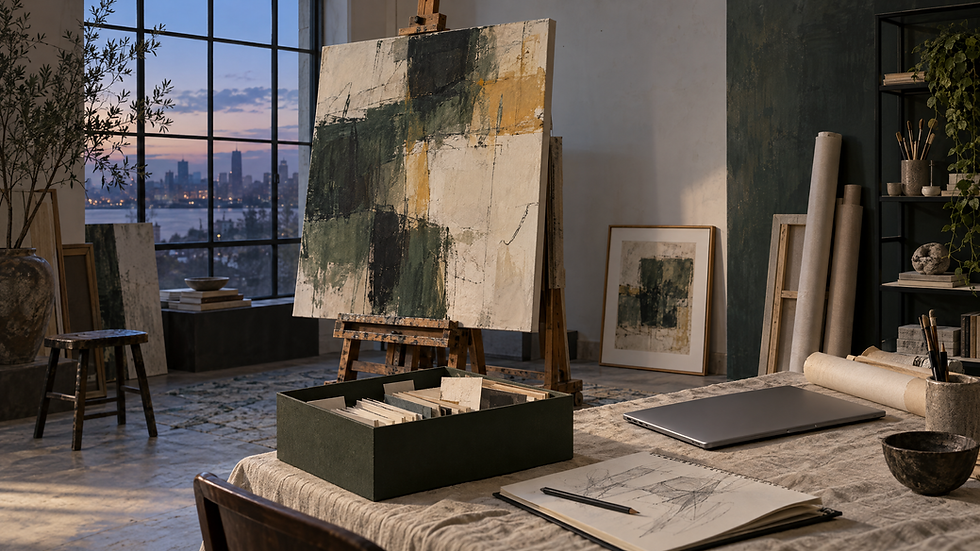
Image disclosure: This is an original editorial illustration, not a documentary photograph, artwork reproduction or exhibition view.
The 2026 Prix Marcel Duchamp brings a practice built from fragments, organisms, sound and anti-colonial archives into the Musée d’Art Moderne de Paris’s collection galleries. The real subject is not anointing a “rising star,” but what happens when a museum’s temporary architecture meets an artist for whom history is never singular or settled.
This is a source-led analysis, not a first-hand review. The public MAM materials identify the four nominees and the exhibition’s setting, but do not publish a worklist or installation documentation for Ntjam’s 2026 presentation; references to individual works below are dated, independently documented earlier projects.
The 2026 Prix Marcel Duchamp is being staged in a condition that is easy to mistake for administrative backdrop. Since renovation work has closed Centre Pompidou’s historic building, the prize has entered a “constellation” period: the Musée d’Art Moderne de Paris will host its nominated-artists exhibition through 2029. This year’s show—open from 2 October 2026 to 7 February 2027—places Joël Andrianomearisoa, Brognon Rollin, Laura Henno and Josèfa Ntjam in a dedicated exhibition within the MAM’s collection galleries, with free entry. Odile Burluraux and Nicolas Liucci-Goutnikov curate it; the winner will be announced at the museum on 22 October. [1]
That arrangement matters more than a change of address. A prize exhibition ordinarily asks visitors to make a quick comparison: four practices, a selection mechanism, a verdict. Placed amid a collection, it becomes a different kind of test. The room is no longer simply a neutral container for new work. It is a public system for ordering modernity—its periods, media and lineages. For Ntjam, an artist who treats images as mobile evidence rather than fixed illustration, that is an unusually charged frame.
The prize’s own language is forthright about cultural infrastructure. Founded by the collectors’ association ADIAF in 2000 and organised with Centre Pompidou, it describes itself as a leading contemporary-art prize, backed by a €90,000 endowment of which €35,000 goes to the laureate. The 2026 jury includes museum directors, collectors and two artists; the nomination began with an ADIAF collectors’ selection committee. [1] [2] ArtReview, in an independent account of the shortlist, calls it France’s most prestigious contemporary-art prize and measures its history through prior winners including Kader Attia and Dominique Gonzalez-Foerster. [3]
Both accounts correctly describe a high-visibility platform. Neither, by itself, quite explains why Ntjam is an incisive candidate for this particular temporary museum arrangement. Her work does not merely add an alternative story to an existing canon. It worries at the assumption that history can be displayed as a settled sequence at all.
A practice made by joining, not illustrating
Born in Metz in 1992 and based in Saint-Étienne, Ntjam works across sculpture, photomontage, film, sound, performance and writing. The MAM’s nomination record gives a useful, non-romantic account of the method: material is gathered from the internet, natural-science books and photographic archives, then assembled as images, words, sounds and narratives. Historical events and scientific discoveries meet African mythologies and science fiction in worlds where fixed systems of naming become unstable. [2]
The important word is assembled. It does not mean that research arrives as a decorative cloud around an image. In a 2024 interview, Ntjam described photomontage as a means of resisting linear history: layers of imagery can render connections between people, places and movements that conventional historical narratives split apart. She has spoken of using family photographs alongside pictures found in archives, and of making source material herself—photographing mould in a fish tank, studying plants under a microscope. [4] The result is not a clean replacement history. It is an image-world in which archival scarcity, biological form and political memory remain visibly entangled.
That distinction protects the work from the easy vocabulary now regularly attached to it. Ntjam herself told ArtReview that “Afrofuturism” had become a label or contemporary-art aesthetic, whereas her earlier work with the Black(s) to the Future collective understood it as research: a way to connect different points. [4] The correction is material as much as theoretical. A root, a membrane, a body beneath water or a piece of perspex is not there to deliver a generic futuristic atmosphere. It can be an organising device—an apparatus for putting colonial violence, diasporic resistance and nonhuman life into provisional relation.
At Fotografiska New York in 2024, Futuristic Ancestry: Warping Matter and Space-time(s) brought that apparatus into legible forms: biomorphic sculptures, video and photomontages printed on plexiglass and aluminium. The independent account in Artsy described how the show drew on her Cameroonian family archives and images of members of the Union of the Peoples of Cameroon, an independence movement. In Fire Next Time (2023), layered fire, water, tree roots and marching silhouettes made underground circulation a visual proposition rather than a historical diagram. [6] The specificity is essential: the work’s gleam is never a substitute for the political material carried in its images.
What an immersive work can teach a gallery
Ntjam’s Venice commission, swell of spæc(i)es (2024), offers the clearest documented measure of the spatial ambition behind the MAM moment. At the Accademia di Belle Arti, LAS Art Foundation presented a cyclical film on a curved LED screen, reflected in a polished black surface, alongside sound, voice and vibration. Fatima Al Qadiri composed its score. Two jellyfish-shaped sound showers were fabricated from biosourced sunflower-seed resin, hemp and hay; a membrane-like structure became a listening and resting space through sound exciters that turned its surface into a haptic speaker. [5]
Those are not incidental production details. They show how Ntjam distributes meaning across body, acoustics, screen, support and duration. The Venice project brought Dogon accounts of Amma and Nommo into contact with a Huaorani creation story, plankton research, stellar matter and histories of forced movement through water. [5] ArtReview further reported that its moving image combined computer and hand-drawn animation, photomontage and AI; scans of objects in Western museum collections met images of anti-colonial figures. [4] No single object carried the full argument. Visitors had to move through a set of relays.
That logic has since been tested at greater civic scale. For INTRICATIONS (2025–26), the Institut d’art contemporain in Villeurbanne gave Ntjam its 1,200 square metres as well as three display windows in the Gare Part-Dieu metro station—her most expansive exhibition to date. Its first dedicated sound installation joined cardboard and bio-resin to video-game engines, AI, sand, metal and song. The point was not breadth for its own sake: the work placed an exhibition’s interior and a commuter route within the same system of transmission, fugitivity and entanglement. [7]
This is why the phrase “within the collections” changes the reading of the current prize show. It should not license conjecture about what Ntjam has installed at MAM, because the public record does not yet provide that information. It does, however, make the exhibition’s institutional situation plain. A collection gallery usually asks an artwork to take its place in a chronology or a category. Ntjam’s past projects ask how the image got there, which bodies or archives were excluded, and what other scales of time—planktonic, ancestral, cosmic, geological—might disturb the category.
There is a productive tension here. The MAM/ADIAF framing emphasises accompaniment, international visibility and a prize with clear stakes. [1] [2] ArtReview’s shortlist report emphasises prestige and lineage. [3] Artsy’s 2024 profile, by contrast, caught Ntjam pushing against an expectation in the French art scene that she choose one medium; it also recorded her insistence that writing keeps a work from ending as a merely pretty picture. [6] These are not incompatible accounts, but they produce different artists. One is a nominee in a national apparatus. The other is a builder of systems that are deliberately difficult to reduce to a single medium, genre or polished visual brand.
The limit of the prize—and the value of the room
A prize inevitably compresses. It asks a committee and jury to distinguish an individual author from a field of practices. Ntjam’s most substantial works, meanwhile, depend on collaboration: the Venice credits name an artistic adviser and writer, producers, animators, a composer, sound specialists, scientific researchers and more. [5] Recognition can make such labour newly visible, but it can also turn a collective technical ecology into the signature of one person. The same risk applies to the shorthand of futuristic Blackness: it can make the work easier to circulate while obscuring its precise archival work and the particular histories it reconnects.
That is a reason to look more carefully, not to dismiss the occasion. The relocation from Pompidou is an instance of how a museum city remakes itself during closure: networks of institutions take on functions that once seemed concentrated in one building. At 11 Avenue du Président Wilson, the prize is not parked while it waits to go home. It is being made public under different conditions, beside another institution’s account of modern art. [1]
For readers interested in design, the exhibition is a reminder that display is never only a matter of walls and lighting; it is an argument about what kinds of relation a room permits. For collectors, it makes a more searching proposition than a forecast of a career: a work’s significance may lie in its refusal to become a self-contained object. And for anyone following Paris’s cultural geography, Ntjam’s nomination offers an unusually lucid occasion to ask what a collection can be when it encounters an artist whose raw materials include scientific images, family archives, sound frequencies and the historical gaps between them.
The title of this moment need not be a prediction of who will take the prize on 22 October. Its stronger claim is architectural and temporal. In the MAM’s collection galleries, the prize room can become a time machine—not because it transports visitors cleanly into a future, but because Ntjam’s method makes the past’s unresolved images active again. The room’s challenge is to let that complexity remain complex.
Sources & records
1. https://www.mam.paris.fr/fr/expositions/exposition-prix-marcel-duchamp-2026 "Musée d’Art Moderne de Paris: Prix Marcel Duchamp 2026"
2. https://www.mam.paris.fr/sites/default/files/documents/press_release_-_nominated_artists_-_prix_marcel_duchamp_2026.pdf "Musée d’Art Moderne de Paris / ADIAF: The Prix Marcel Duchamp 2026 — nominated artists press release"
3. https://artreview.com/prix-marcel-duchamp-2026-shortlist-announced/ "ArtReview: Prix Marcel Duchamp 2026 shortlist announced"
4. https://artreview.com/the-interview-josefa-ntjam/ "ArtReview: The Interview — Josèfa Ntjam"
5. https://www.las-art.foundation/explore/digital-booklet-josefa-ntjams-swell-of-spaecies "LAS Art Foundation: Digital Booklet — Josèfa Ntjam’s swell of spæc(i)es"
6. https://www.artsy.net/article/artsy-editorial-rising-star-josefa-ntjams-shimmering-otherworldly-works-illuminate-afro-diasporic-history "Artsy: Rising Star Josèfa Ntjam’s Shimmering, Otherworldly Works Illuminate Afro-Diasporic History"
7. https://i-ac.eu/en/exhibitions/24_insitu/2025/769_INTRICATIONS "Institut d’art contemporain: INTRICATIONS — Josèfa Ntjam"

$50
Product Title
Product Details goes here with the simple product description and more information can be seen by clicking the see more button. Product Details goes here with the simple product description and more information can be seen by clicking the see more button

$50
Product Title
Product Details goes here with the simple product description and more information can be seen by clicking the see more button. Product Details goes here with the simple product description and more information can be seen by clicking the see more button.
$50
Product Title
Product Details goes here with the simple product description and more information can be seen by clicking the see more button. Product Details goes here with the simple product description and more information can be seen by clicking the see more button.

Comments