Can Art Critique AI Images Without Repeating Their Logic? Hito Steyerl’s Test

Reported Explainer | Visual-Culture Analysis
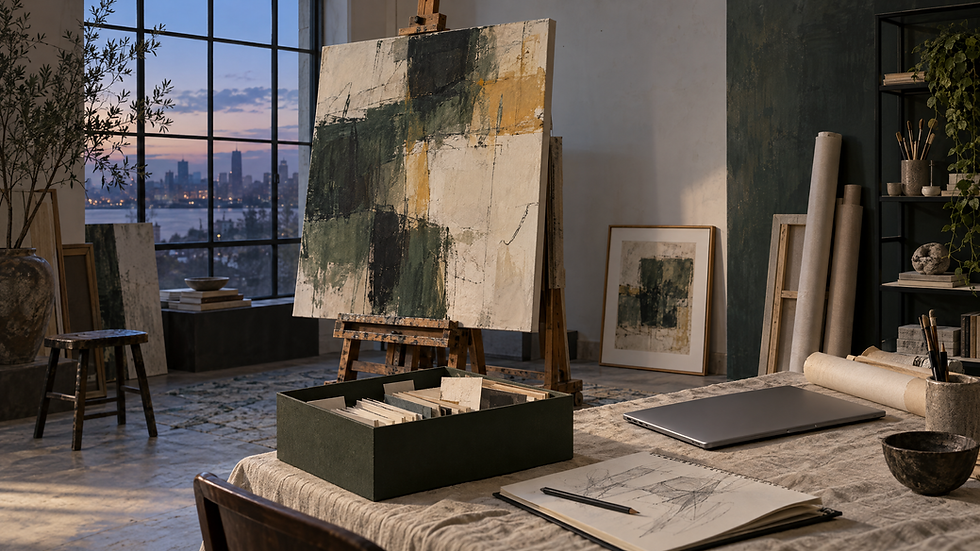
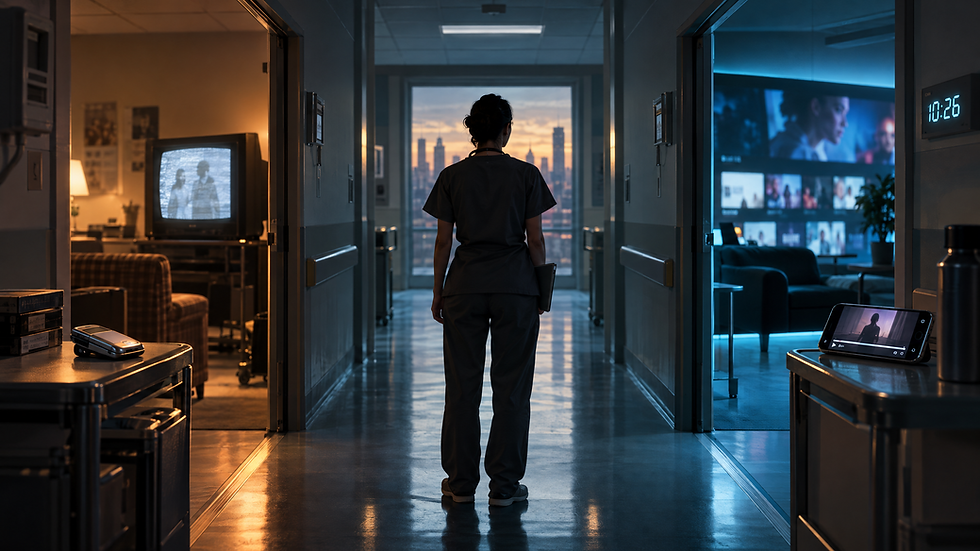
Image disclosure: This is an original editorial illustration, not a documentary photograph, artwork reproduction or exhibition view.
At Milan’s Osservatorio Fondazione Prada, The Island makes a case for research, human testimony, and material time against synthetic-image churn—while critics disagree over whether its own excess gets in the way.
This is a records-based reported explainer, not a first-hand exhibition review. It draws on Fondazione Prada’s exhibition materials, Steyerl’s published interview, and independent criticism; the writer did not attend The Island.
Date line: 13 October 2026
The image flood has a history
Hito Steyerl’s The Island is in its final weeks at Osservatorio Fondazione Prada in Milan, open through 30 October. The site-specific project joins a new 26-minute film to sculptural installations and extended video interviews. Its recurrent flood is at once literal, historical, and algorithmic: a figure for climate emergency, generative-image circulation, authoritarian politics, and the vulnerability of scientific inquiry. [1] [2]
This is why the work has acquired urgency beyond the usual exhibition-season chatter. Arguments about AI imagery are often reduced to detection: can one spot the counterfeit photograph or the synthetic video? Steyerl is concerned with the more consequential question of conditions. What occurs when visual culture prizes velocity, recognizability, and affective force while severing an image from the people, places, and methods through which a claim might be tested? The public stake is not that artists have been replaced by software. It is that the habits of attention required for shared reality can be thinned out, frame by frame.
Steyerl gives that problem an intentionally ungainly allegorical form. Flash Gordon, played by actor Mark Waschke, appears in Korčula, the Croatian island town around which the work’s research converges. [3] AI-generated sequences meet archaeological evidence, quantum physics, an account by the science-fiction scholar Darko R. Suvin, and Dalmatian choral singing. The official record divides the project among four linked strands: “The Artificial Island,” “Lucciole,” “The Birth of Science Fiction,” and “Flash!” [2] Their collision does not invite viewers to mistake fiction for fact. It asks a more difficult question: which connections are demonstrated, which are imagined, and who remains accountable for the difference?
Suvin’s presence supplies more than a cultured reference to science fiction. The exhibition materials recall his memory of responding to a 1941 bombing attack in fascist-ruled Zagreb by imagining himself inside a Flash Gordon serial, and connect that act of mental displacement to his later theorizing of the genre. [1] Fantasy, in this account, is not the opposite of truth. It can be a means of estranging the present—of seeing its arrangements as contingent rather than inevitable. That is distinct from the synthetic image’s contemporary promise of frictionless plausibility. One opens a distance in which to think; the other can make the world’s complexity feel already processed.
A choreography of evidence
The exhibition’s counterproposal to synthetic-image churn is not an immaculate picture of the real. It is an arrangement of witnesses, materials, and credits. On Osservatorio’s first floor, the project begins with a 3D documentary scan of a submerged Neolithic artificial island near Korčula, discovered in 2021 by archaeologist Mate Parica. Four screens offer expanded interviews with Parica; quantum physicist Tommaso Calarco; language historian Sachi Shimomura; and Suvin. Upstairs, the film pulls fragments of their testimony into a cinema-like environment; nearby projections of the site and its artifacts alter in response to visitors’ presence. [2]
The guide gives the archaeological object sufficient density to resist its use as scenic atmosphere. It describes a seven-sided prehistoric settlement, once connected to the coast by a narrow walkway, now beneath roughly 4.5 meters of Adriatic water after some 7,000 years. [2] The point is not to make archaeology authenticate every speculative leap that follows. It is to introduce a temporal scale that the feed cannot easily absorb: a material remnant, documented through research, whose meaning is recovered slowly and remains open to revision. The installation’s visual language—a scan, a projection, a responsive surface—does not abolish mediation. It makes mediation part of the subject.
“Lucciole” adds another scale. The project brings in the work of the chemist Osamu Shimomura, whose research on bioluminescence and green fluorescent protein is recounted through his daughter, the language historian Sachi Shimomura. Fondazione Prada’s guide notes applications for GFP as a marker in medical screening and as a means of tracing environmental change. [2] In the exhibition’s argument, luminous plankton and drifting jellyfish are not a natural-world corrective to the digital. They are reminders that vision is technical, biological, and collective long before it becomes a prompt.
That arrangement is an institutional procedure as much as an aesthetic decision. Within a private foundation, research is not simply cited in wall text but staged across two floors: the visitor encounters source material, modeled imagery, and a film that re-edits both. The foundation’s digital guide retains names, roles, practical access information, and the sequence of the installation after the encounter itself has ended. [2] None of this confers automatic truth. Archaeology and physics cannot serve as solemn props, nor can they settle the political consequences of AI. Yet the return to named interlocutors and fuller speech resists a familiar visual economy, in which authority arrives as an image stripped of a route back to its source.
The human pressure within the project is specific. Parica’s research concerns an actual submerged settlement. Shimomura’s material touches work connected to bioluminescence. Suvin describes science fiction as a mental exit during a bombing attack on Zagreb in 1941. These are not interchangeable emblems of “reality.” They are forms of situated knowledge, with histories and limits, easily flattened when catastrophe or science is used as ready-made visual atmosphere. [2]
The institution is part of the argument
Osservatorio is not a neutral screen for this inquiry. The venue sits in Milan’s Galleria Vittorio Emanuele II, and The Island occupies both of its levels. Its official access pattern—weekday entry from 2 p.m., weekend entry from 11 a.m., closure on Tuesdays, with last admission at 7:30 p.m.—is a modest but concrete reminder that sustained attention is always organized by institutions, hours, transport, and the permission to linger. [2] A 26-minute film and four extended interviews make a different demand from a clip that passes without sound through a social feed.
That difference deserves attention without turning it into a virtue by default. A foundation can give an artist the space, technical capacity, and editorial time to assemble difficult materials; it can also frame those materials inside a cultural economy that remains selective in who has time, proximity, or confidence to enter. The Island cannot dissolve that contradiction. What it can do is make duration conspicuous. It turns the gallery into a place where viewers are asked to shuttle between an ancient coastal structure, the history of anti-fascist imaginative survival, scientific explanation, and a deliberately ugly contemporary image stream.
This is also why the project’s “deep time” is not an escapist mood. In the official account, it is set against the dislocated “junk time” of technology-driven capitalism: a regime of jumps, loops, and interruption. [1] The contrast risks becoming too neat. Deep time can be aestheticized, just as easily as the chaotic present. Still, the juxtaposition names a real formal problem: an accelerated visual culture makes time feel as though it belongs only to the newest image, while climate processes, excavation, and historical testimony unfold on other clocks.
When critique borrows the visual grammar it distrusts
Steyerl does not present herself as demanding a blanket refusal of these tools. In a 2025 interview, she allowed that artists might make critical use of AI if it worked against the industry’s hype, arms-race logic, and techno-authoritarianism. She also argued that technology cannot substitute for cooperative human infrastructure. [6] The distinction matters. It shifts attention from an image’s origin alone to the system around it: ownership, extraction, the management of visibility, and the social institutions that make verification possible.
Independent critics disagree over whether The Island achieves its own standard. J.J. Charlesworth in ArtReview sees the interviews, archaeology, and choral conclusion as a turn toward embodied voices and material relations amid degraded image culture. [3] Hili Perlson in Artforum reaches a more skeptical verdict: the work’s stacked screens, glitches, theoretical fragments, and digital grotesquerie risk reproducing the fatigue and confusion they seek to diagnose. [4] Emanuela Zanon, writing in Finestre sull’Arte, instead reads the difficult connective logic of the four narratives as a way of making interdependence legible without simplifying it. [5]
The dispute is central, not incidental. Art that opposes attention-hungry images cannot assume that a greater density of stimuli becomes criticism. But a frictionless, instantly legible denunciation of AI would inherit the same economy of easy consumption. The relevant standard is neither technological purity nor pedagogical neatness. It is whether the work exposes its own edits and dependencies, and whether it returns spectators to the contested world from which its imagery is drawn.
Here, the use of montage matters. Steyerl does not offer a forensic tutorial or a clean moral fable. In the film, Flash meets an AI-made double amid Italian-brain-rot imagery and a brown digital flood: a staged version of the problem that critique may answer slop with more slop. [3] [4] She makes a collage whose seams stay visible: a scanned ruin, a comic-book hero, a research interview, changing light, and a choir that holds different voices together without collapsing them into a single line. That compositional decision has risks. The weight of references can make the work feel like the image culture it rebukes: crowded, agitated, insistently self-consuming. It also permits a refusal that much contemporary platform imagery does not: the refusal to reduce people, evidence, and historical pain to a perfectly optimized visual point.
The test after the exhibition
For readers in Milan, the project remains open until 30 October. At a distance, Fondazione Prada’s digital leaflet is the more durable document: it identifies participants, narrative strands, installation sequence, and the relation between research material and fiction. [1] [2]
The enduring question is practical but not simple. When an image purports to show a crisis, a scientific claim, or a community, whose knowledge has been compressed into it? Can its route be followed? Does its form create time for judgment, or only the reflex to pass it on? The Island does not resolve those questions. Its achievement is to make them inseparable from the way images are made, exhibited, and believed.
Sources & records
[1] Fondazione Prada, “The Island — Hito Steyerl” (official exhibition record; dates, venue, project description, and digital guide). https://www.fondazioneprada.org/project/the-island-hito-steyerl/?lang=en
[2] Fondazione Prada, Hito Steyerl: The Island digital leaflet (official project guide; layout, contributors, work descriptions, access record, and film duration). https://www.fondazioneprada.org/wp-content/uploads/Leaflet_The-Island_digital_ENG.pdf
[3] J.J. Charlesworth, “Hito Steyerl’s ‘Conservative’ Turn,” ArtReview, 19 December 2025 (independent criticism; work description and interpretation of materiality, voice, and AI imagery). https://artreview.com/hito-steyerl-the-island-fondazione-prada-review-jj-charlesworth/
[4] Hili Perlson, “Hito Steyerl,” Artforum, March 2026 (independent criticism; documented installation details and critique of overload). https://www.artforum.com/events/hito-steyerl-fondazione-prada-review-1234744539/
[5] Emanuela Zanon, “When Art Hacks AI and Reality: What Hito Steyerl’s The Island Looks Like at the Fondazione Prada,” Finestre sull’Arte, 9 February 2026 (independent criticism; account of the installation’s interlinked narrative structure). https://www.finestresullarte.info/en/exhibition-reviews/when-art-hacks-ai-and-reality-what-hito-steyerl-s-the-island-looks-like-at-the-fondazione-prada
[6] Günseli Yalcinkaya, “Hito Steyerl: ‘Who Prompted All This Shit?’,” Spike Art Magazine, 25 July 2025 (artist interview; Steyerl’s stated position on critical AI use and collective infrastructure). https://spikeartmagazine.com/articles/interview-hito-steyerl

$50
Product Title
Product Details goes here with the simple product description and more information can be seen by clicking the see more button. Product Details goes here with the simple product description and more information can be seen by clicking the see more button

$50
Product Title
Product Details goes here with the simple product description and more information can be seen by clicking the see more button. Product Details goes here with the simple product description and more information can be seen by clicking the see more button.
$50
Product Title
Product Details goes here with the simple product description and more information can be seen by clicking the see more button. Product Details goes here with the simple product description and more information can be seen by clicking the see more button.

Comments