Gwangju Biennale’s Tighter Core Makes a Big Claim: Is Change a Practice Rather Than a Spectacle?

Scope note: This is a records-based news analysis, prepared from official materials and independent reporting verified on October 13, 2026; it does not claim firsthand attendance. A March preview projected 45 artists from 20 countries, while the Biennale’s June announcement names 43 artists and groups; this analysis uses the later figure. The premise remains current, so the title has not been narrowed. [1] [2]
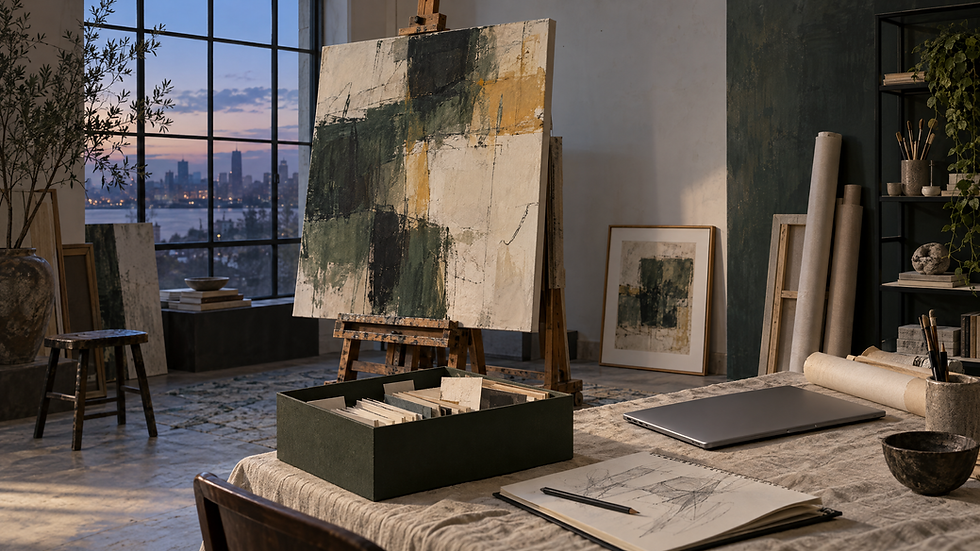
Image disclosure: The cover is an original editorial illustration, not a documentary photograph and not a reproduction of an exhibited artwork. It was made to evoke the exhibition’s five fields of inquiry without depicting victims, protest imagery, named artists, or any particular work.
An imperative, not an alibi
The 16th Gwangju Biennale, You Must Change Your Life, remains open through November 15. Its title borrows the closing injunction of Rainer Maria Rilke’s 1908 poem Archaic Torso of Apollo. In Rilke, a broken sculpture acquires the pressure of an address: the viewer is summoned, rather than merely moved. Gwangju’s curatorial proposition shifts that pressure from revelation to duration. Change, its main-exhibition guide argues, is not only the visible break but a process carried by repeated acts that reshape bodies, perceptions, and relations. [3]
That is a pointed intervention in the syntax of the international biennial. Such exhibitions often translate crisis into visual abundance: many names, many nations, many urgent propositions arriving at once. Artistic director Ho Tzu Nyen and curators Che Kyongfa, Park Gahee, and Brian Kuan Wood choose a slower tempo. Their five galleries move from molecules to bodies, cultivated landscapes, cosmic time, and air. This is not a neutral taxonomy. It stages material, social, and sensory life as interdependent fields in which a practice might alter its conditions, increment by increment. [3] [4]
The argument enters its final public stretch now. From November 6 to 8, the Biennale plans performances, workshops, screenings, and conversations at the Exhibition Hall, Geosigi Hall, and outdoor sites before its close. Announced participants include Angela Goh, Nam Hwayeon, Suzuki Akio and Miyakita Hiromi, Geumhyung Jeong, and Christian Nyampeta; the detailed timetable has not been published and the official events page still says the full program and schedule will be announced soon. [5] The coming events will test whether practice is a curatorial refrain or a form of encounter with consequences beyond the gallery.
The exhibition’s grammar of scale
The official sequence gives the proposition a deliberately physical grammar. Molecules and Me begins with matter beneath ordinary perception; Bodies and Bonds considers training, illness, intimacy, and family; Landscapes and Learning turns toward cultivation, labor, schools, and communal knowledge. The final rooms, Cosmos and Change and Air and Articulations, extend that inquiry into geological time, moving image, breath, sound, and language. [4] The progression resists the neat march from individual selfhood to collective redemption. Instead it insists that the body, its habits, a field, a classroom, and an atmosphere are all sites where power is felt and revised.
The artists named in the release make the choice of practice more than a curatorial mood. Tehching Hsieh’s severe, long-duration performances have made lived time his material; Amanda Heng’s long photographic work with her mother records care and its changing arrangements over decades. Independent criticism of this edition also discusses James T. Hong’s approximately eleven-hour compilation of public apologies by political figures. [2] [10] These are works whose temporal demand exceeds the quick extract, the press image, or the biennial checklist. They ask what becomes visible when attention is treated not as a scarce commodity but as an ethical medium.
That does not automatically make slowness virtuous. Duration can become another form of cultural distinction if institutions offer only the already initiated enough time, language, money, or physical ease to participate. Yet Gwangju’s thematic turn matters because it asks a different question of art’s public life. Not what transformation can this object symbolize, but what habits of noticing, making, and relating have been built to bring this object into being. That question has consequences for the infrastructure around a work: research budgets, interpretation, educational programs, labor, and the distribution of time.
The form of a tighter main exhibition
Small here names the main exhibition’s structure, not the entire citywide event. Alongside Ho’s show, the Foundation says 28 national and institutional pavilions operate as a separate, voluntary external-collaboration project: 16 national participants, 11 institutional participants, and one institution presenting two pavilions. [12] The Biennale’s June announcement lists 43 artists and groups, including Hsieh, Heng, May Mothers House, and the Gwangju painter and agricultural educator Heo Baekryeon with the school he founded. [2] In March, Artforum reported a projected 45 artists and collectives from 20 countries—the event’s smallest cohort since 1995—and relayed Ho’s case for density rather than expansion. [1] The later list corrects the number, not the wager: fewer positions, more room to make a history of a practice legible.
That separation has proved more than bureaucratic. In August, the Foundation’s listing of a Taiwan Pavilion under the name of its organizing museum drew objections from participating artists and curators and from Taiwan’s Ministry of Culture; the full pavilion name was restored. The Foundation says the earlier label followed its distinction between national and institutional participants and that it does not control pavilion content. [12] [13] The disagreement does not belong to Ho’s central exhibition as such, but it is part of the international institution whose claims the show must inhabit.
The contrast is sharper against the Biennale’s own origin story. Patrick Langley’s history of Korean biennials for e-flux records that Gwangju’s 1995 debut assembled 87 artists from 49 countries and drew 1.6 million visitors across 62 days. [8] That was a newly democratizing city claiming an international cultural horizon. Three decades later, a reduced cohort is not simply an aesthetic preference. It signals unease with the expansionary measure by which biennials have often asserted their relevance: more artists, more pavilions, more destinations on the global art calendar.
International surveys commonly assign artists a compressed representative role. A tighter roster can instead trace an oeuvre, a long project, or a web of affinities. It permits an artwork to appear not simply as a finished object but as the visible residue of study, exercise, refusal, care, collaboration, or time. This is an art-historical proposition as much as an administrative one: the unit of attention becomes practice, rather than the isolated work made legible for a touring public.
But concentration is not innocent. It intensifies the authority that decides which practices receive international attention, and it cannot in itself guarantee equitable fees, accessibility, or local accountability. The important measure is operational. Do the exhibition’s resources, interpretive materials, translations, and public programs let artists and local collaborators remain more than illustrations of an elegant thesis? The Biennale’s claim will be persuasive only if its conditions of production carry the care it assigns to the work.
A city whose history resists easy use
Gwangju raises the stakes of that test. The May 18 Democratic Uprising began in 1980 as protest against military rule and was violently suppressed. Its surviving record includes citizens’ statements, hospital files, photographs, film, court materials, and later testimony; UNESCO placed the archive on its Memory of the World Register in 2011. [6] The Foundation says the Biennale was founded in 1994 to commemorate May 18 and the fiftieth anniversary of Korea’s liberation; the first edition opened the following year. [7] [8]
The archive matters because it keeps the event from becoming a floating emblem. Its documents preserve the administrative as well as the intimate trace: testimony beside state records, private grief beside the mechanisms that sought to control the public account. In the Biennale’s own preparatory program, a March session of GB TALKS examined videotapes, cassette tapes, and woodblock prints as reproducible media that circulated images and messages under censorship during South Korea’s democratic movement. The speakers included the moving-image historian Han Jae Sup, music scholar Choi Yu Jun, and artist Hong Sung-dam. [11] That is a more exact frame for the phrase art and politics than a generic appeal to creative resistance.
That lineage is a responsibility, not atmospheric capital. Langley recalls that local artists criticized the 1995 edition for allowing an expensive international format to soften a painful local history. An anti-biennale at a cemetery for victims followed. [8] The episode does not discredit Gwangju’s project. It establishes that its marriage of democratic memory and global contemporary art has always been contested—and that Gwangju spirit cannot function as a moral seal applied in advance.
Ho’s central question becomes more exact in that light. Political change in Gwangju was neither aesthetic figure nor completed event. It involved people organizing, recording, grieving, and contesting the terms through which the uprising would be remembered. Art may hold and circulate memory, complicate a public image, or furnish forms for attention. It does not substitute for democratic action. A responsible exhibition must preserve that distinction rather than turn historical struggle into a scene of uplift.
May Mothers House and the terms of attention
May Mothers House gives the Biennale’s proposition a particular human contour. The institution will present paintings by members of the collective. [2] Independent local reporting identifies the May Mothers’ Association as women whose family members were killed, imprisoned, or injured during the uprising, and describes its extended work of testimony, commemoration, and democratic organizing. [9]
An independent report on this edition says the display includes 322 paintings made through workshops since 2022, accompanied by interviews; their subjects include the uprising and the long aftermath of family life. [10] The scale of that number matters less as an achievement metric than as a record of repetition: images made over time, within a group whose relation to May 18 is lived rather than adopted. In this context, painting is neither a decorative supplement to testimony nor a therapeutic slogan. It is one medium through which memory remains collective, revisable, and present-tense.
The project should not be asked to prove that art heals political violence, nor should bereaved people be enlisted as an exhibition’s emotional guarantee. It does, however, make the Biennale’s thesis answerable. Are the painters’ authorship, their workshop conditions, and their own accounts present in the exhibition’s framing? Or is their persistence being made to certify an institutional idea of transformation? This is not an ancillary ethics question. It distinguishes a sustained relation with a local collective from a moving example inserted to secure a theme.
What remains after the event
The Biennale has already placed some of its intellectual work outside the exhibition hall. GB TALKS connects historical media practices to contemporary cultural work; the related GB Artist Focus program has partnered with seven local art spaces for conversations around artists based in Gwangju and Jeollanam-do, with recordings intended for the Biennale’s YouTube channel. [5] [11] These are modest mechanisms beside the prestige machine of an international biennial, but they are the kind through which an institution either builds local continuity or merely borrows its setting.
Before November 15, watch how the closing program distributes authority among artists, curators, and publics. Then watch for the records that survive the 72-day run: documentation, translation, artist materials, and a credible account of what the Foundation will sustain after the galleries empty. [5]
Gwangju’s most rigorous claim is narrower than art changes the world. It is that change may be practiced through repetition, attention, and relationships that enlarge the capacity to act. The claim does not abolish the distance between cultural symbolism and political power. It renders that distance visible, then places the burden back on the Biennale to demonstrate—in its own working life—what practice means once the spectacle has passed.
Sources & records
[1] Artforum: Title, Theme Announced for 2026 Gwangju Biennale — https://www.artforum.com/news/title-theme-announced-for-16th-gwangju-biennale-1234745396/
[2] Gwangju Biennale: 16th Gwangju Biennale announces 43 participating artists and groups — https://gwangjubiennale.org/en/Board/12157/detailView.do
[3] Gwangju Biennale: You Must Change Your Life—main exhibition overview — https://www.gwangjubiennale.org/en/exhibition/biennale/mainexhibition.do
[4] Gwangju Biennale: You Must Change Your Life—exhibition sections — https://www.gwangjubiennale.org/en/exhibition/biennale/mainexhibition.do?subPage=intro
[5] Gwangju Biennale: 16th edition events, closing program, and GB Artist Focus — https://gwangjubiennale.org/en/events/info.do
[6] UNESCO International Centre for Documentary Heritage: 1980 Archives for the May 18 Democratic Uprising — https://www.unescoicdh.org/eng/sub.php?menukey=289&mod=view&no=63696&listCnt=10&code1=00000003&code2=00000032
[7] Gwangju Biennale: Ho Tzu Nyen appointed artistic director of the 16th edition — https://gwangjubiennale.org/en/Board/11906/detailView.do
[8] Patrick Langley, e-flux Criticism: Exhibitions of Resistance—A Short History of Korea’s Biennials — https://www.e-flux.com/criticism/6782466/exhibitions-of-resistance-a-short-history-of-korea-s-biennials
[9] Gwangju News: The May Mothers of Gwangju — https://gwangjunewsgic.com/community/the-may-mothers-of-gwangju-may-2025/
[10] Culture.pl: Gwangju Biennale 2026—Travelling Through Time & Cultures — https://culture.pl/en/article/gwangju-biennale-2026-travelling-through-time-cultures
[11] Gwangju Biennale: GB TALKS #1—Circulating Images, Shared Songs — https://gwangjubiennale.org/en/Board/12051/detailView.do
[12] Gwangju Biennale Foundation: Statement on the NTMoFA Pavilion and the 2026 Pavilion project — https://gwangjubiennale.org/en/Board/12158/detailView.do
[13] ArtReview: Taiwan name restored to Gwangju Biennale pavilion — https://artreview.com/taiwan-name-restored-to-gwangju-biennale-pavilion/

$50
Product Title
Product Details goes here with the simple product description and more information can be seen by clicking the see more button. Product Details goes here with the simple product description and more information can be seen by clicking the see more button

$50
Product Title
Product Details goes here with the simple product description and more information can be seen by clicking the see more button. Product Details goes here with the simple product description and more information can be seen by clicking the see more button.
$50
Product Title
Product Details goes here with the simple product description and more information can be seen by clicking the see more button. Product Details goes here with the simple product description and more information can be seen by clicking the see more button.

Comments