
After the Spectacle: What Es Devlin’s Studio Archive Gives Back to the Museum

Format: Think piece — records-based analysis.
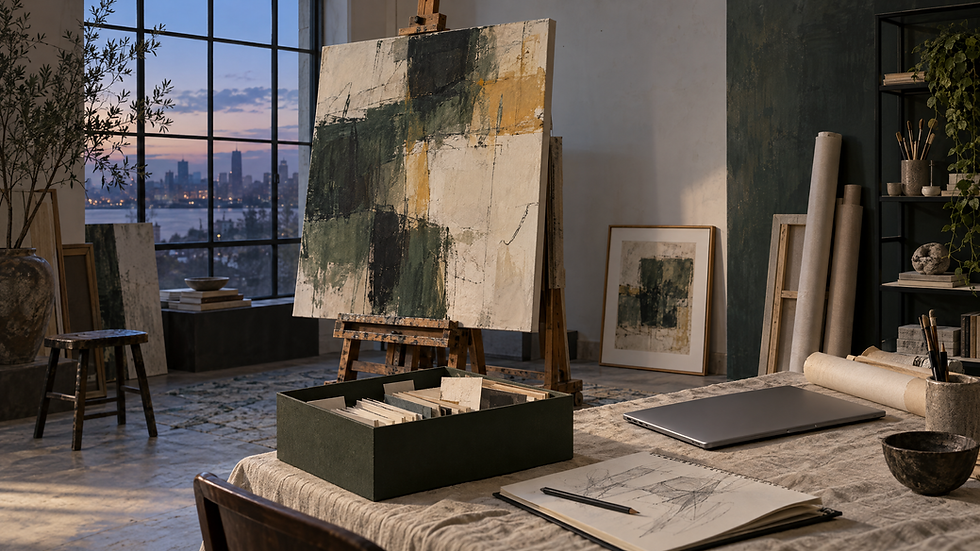
Image disclosure: The leading image is an original editorial still life, not a museum photograph or a reproduction of the artist’s work.
Deck: At London’s Design Museum, Es Devlin’s vast public images are returned to their smallest units: paper, paint, a revolving maquette, a shelf of marked-up books. The result is an unusually lucid argument for the archive as an active instrument, even as it exposes the limits of turning collaborative, time-bound work into a single artist’s legacy.
London — 13 October 2026
Scope note: This analysis draws on the Design Museum’s exhibition record, independent reporting by Wallpaper and Designboom, and institutional records of Devlin’s prior work. It does not claim firsthand attendance.
The contemporary spectacle often leaves the room before criticism can arrive. A concert stage is dismantled overnight; a ceremonial image survives as a circulating clip; an immersive installation is remembered as an atmosphere rather than an object with a working method. Es Devlin’s work has lived precisely in that condition. Across theatre, opera, stadium tours, ceremonies and public installations, she has made spatial propositions for audiences in motion—narrative machines calibrated to be entered, watched, sung through, or filmed from a distance. [4] [6]
Es Devlin: Other Worlds, at London’s Design Museum from 2 October 2026 to 4 April 2027, changes the scale of that encounter. The museum calls it the first European retrospective of Devlin’s 30-year creative practice and the largest solo presentation of her archive to date. Its premise is not simply that a celebrated maker of environments deserves a museum survey. It is that the preparatory matter—drawings, school-era notebooks, collages, diaries, models, books and working tools—can explain how an environment becomes thinkable before it becomes grand. [1]
That distinction makes this an exhibition about artistic transmission as much as career consolidation. Devlin’s earlier 2023–24 Cooper Hewitt exhibition, An Atlas of Es Devlin, was described by that museum as her first monographic museum exhibition. Cooper Hewitt located a continuity from small theatres in 1995 to opera, civic commissions, stadium-scale events and installations, with reading, drawing and small cardboard models as the recurring point of departure. [4] London is therefore not an inaugural revelation but a consequential reframing: an American museum had made the archive legible as an atlas; the Design Museum returns it to the city and discipline in which stage design, exhibition design and urban public culture overlap.
The desk makes a different claim for spectacle
The exhibition’s governing device is the 30-Year Desk, a large circular display built for the gallery. Its contents link a set design for The Lehman Trilogy, the 2012 London Olympic Closing Ceremony, the 2022 Super Bowl halftime show and Forest of Us, Devlin’s 2021 immersive work in Miami, among other projects. [1] Independent accounts make the desk’s density more specific: Wallpaper reports 5,000 objects from Devlin’s personal archive, 30 revolving models and hundreds of sketches; Designboom describes concentric desks gathering drawings, photographs and more than 30 models. [2] [3]
The numbers matter less as abundance than as an answer to a familiar misunderstanding. Devlin’s large public commissions can look born at full size, resolved by technical virtuosity and the authority of the final image. The desk insists on recurrence instead. It restores the pauses, substitutions and returns that the finished spectacle necessarily conceals: a sketch becomes a cut-cardboard volume; a volume is lit; the lighting changes the implied path of an audience; an old experiment is carried into an altogether different venue.
This is not a romance of roughness. The model is a technical instrument as well as a precious remnant. Cooper Hewitt’s record, for example, specifies a recreated Lehman Trilogy model made from painted MDF, acrylic, cardstock, 3D-printed resin, brass and LED. [4] Read beside a project such as Forest of Us, the detail clarifies Devlin’s medium. The Miami installation began as a film whose screen is periodically perforated so visitors can pass into a mirror maze; it works through the visual affinity of bronchial trees and arboreal branches. Superblue describes a process that moved between paper-and-pencil studies, research and traced X-rays of the bronchial system. [5] The striking image is not the idea’s endpoint. It is a temporary settlement between drawing, research, fabrication, light and the bodies expected to move through it.
In a museum, that settlement becomes inspectable. A stage designer’s most durable contribution may not be a particular set or an immediately recognisable silhouette. It may be a method for asking what a room permits a crowd to feel, and how a text, a scientific diagram or a poem can be given bodily scale. The Design Museum’s display has the intelligence to treat the archive as evidence of this method rather than as an after-party for famous commissions.
From the studio to the public room
The route described by the museum and by independent coverage begins in a detailed reproduction of Devlin’s London studio, with books, objects and maquettes; a video carries her voice. It then moves through an illuminated, mirrored presentation of Come Home Again, the 30-Year Desk and archive material, before ending with Infinite Library. [1] [2] That sequence is unusually explicit: workspace, accumulated practice, reading. It turns the visitor’s route into a proposition about cause and effect.
Entry is also timed around a short introductory film, retaining the staged threshold of a performance before the visitor encounters the working matter. [1]
At the beginning of the exhibition, the studio is not offered as an intimate lifestyle interior. It is a working ecology: the place where publications, paint, tools and models are kept close enough to affect one another. The adjacent Archive Unboxed brings together sketches, paintings, collages, diaries and prints made from Devlin’s school years onward. The Design Museum presents these as proof that drawing is the origin point for every project. [1] One need not accept an origin story so cleanly to see what it productively does. It makes drawing a verb rather than a brand signature: a way of carrying an image across disciplines without pretending that the image alone built the room.
The reappearance of Come Home Again makes a related case. Originally shown outside Tate Modern in 2022, its illuminated cut-out drawings enumerate endangered London species; its earlier structure drew on a section of St Paul’s Cathedral’s dome. [3] In Kensington, the work is installed below a mirrored ceiling, according to Designboom, while the museum describes it as a shrine dedicated to endangered wildlife, newly arranged as a changing constellation. [1] A public artwork about interdependence is thus placed inside an apparatus of reflection. The visual transformation is not incidental. It makes a work first calibrated to a particular London exterior available as a museum image—but it also risks translating ecological relation into a beautifully self-enclosed scene.
The final work sharpens the exhibition’s strongest idea. Infinite Library is an eight-metre-wide triangular bookshelf containing more than 2,000 colour-arranged volumes; it rotates above a circular mirror, with projections across the shelves and recordings of Devlin reading selected passages. Designboom identifies James Gleick’s Chaos, Toni Morrison’s Beloved and Margaret Atwood’s Oryx and Crake among the books from her own working collection. [3] The Design Museum says that Penguin Random House UK supplied the books and that they will be donated to local charities after the exhibition, in connection with the National Year of Reading 2026. [1]
It also follows Devlin’s earlier library works in Milan, Miami and Yorkshire, and is the first in that series to be installed inside a museum. [3]
That planned dispersal is more than a generous coda. A library in an exhibition can too easily turn reading into scenery—spines organised as a colour field, citation as decor. Here, rotation, sound and reflected space make that danger conspicuous. Yet the books’ promised exit refuses the closed circuit of the artist archive. A museum object will be unmade into a social resource. The gesture cannot solve the institutional conditions that make access to books uneven, but it gives the exhibition a material afterlife beyond Devlin’s name.
What the archive cannot settle
That confidence needs the counterweight of a pointed dissent. Time Out finds the sleek display and pervasive score too mannered, and argues that a museum presentation cannot recover the force of Devlin’s work onstage; the review’s objection is a useful reminder that technical evidence and lived event do not coincide. [7]
The other independent accounts broadly support the museum’s framing, while revealing its pressure point. Wallpaper calls the presentation both intimate and sweeping and records Devlin’s explanation that she has offered young designers “every trace that led me along the way” so they can see how a practice develops over three decades. [2] Designboom similarly finds the small scale of the school-era sketches striking against the arena-sized projects they preceded. [3] Their shared emphasis is telling: the show earns its intimacy not by reducing the ambitions of Devlin’s work, but by making ambition’s working debris available.
Still, an archive is not a transparent moral record. Devlin’s projects require production knowledge held by many people: performers, musicians, dramaturgs, fabricators, lighting and video teams, engineers, producers, venue staff and audiences who complete an environment by inhabiting it. The Design Museum names the exhibition’s curators—Johanna Agerman Ross, Danielle Thom and Margherita Dosi Delfini—as working in collaboration with Devlin and her studio; Cooper Hewitt’s record of the earlier show also credits exhibition fabrication, graphic design, projection, sound, lighting and audiovisual integration to a broad group of contributors. [3] [4] Those credits are important precisely because a retrospective’s beautiful coherence can make an individual author seem more solitary than the works ever were.
Devlin’s studio record makes the practical point sharper: associate designers regularly collaborate on initial concepts and design intent, while the teams that develop and deliver the work expand with a project’s scale. [8]
This is the credible limit of the desk’s achievement. Models can show decisions; they cannot replay the labour, negotiation, risk or timing by which an idea survives contact with a theatre, a civic site or a crowd of 70,000. Nor should the museum pretend that an archive makes an ephemeral work permanent. The most it can offer is a score: partial, material and open to re-reading.
That is also why the exhibition matters now. Museums are under pressure to make experience visible, shareable and immersive; Devlin has long understood how those demands operate in public. But Other Worlds proposes a more demanding form of access than the instant image. It asks viewers to linger over increments: the line on paper, the folded card, the research book, the turning model and the institutional labour required to move any of them into public space. In the process, the museum receives something rare from spectacle—not its residual glamour, but its instructions for paying attention.
Sources & records
[1]: https://designmuseum.org/exhibitions/es-devlin-other-worlds "Design Museum: Es Devlin: Other Worlds"
[2]: https://www.wallpaper.com/design-interiors/design-events/es-devlin-design-museum-london "Wallpaper*: How a practice evolves over 30 years: Es Devlin at the Design Museum is both intimate and sweeping"
[3]: https://www.designboom.com/design/es-devlin-rotating-library-2000-books-london-design-museum-other-worlds/ "Designboom: Es Devlin’s Infinite Library rotates with more than 2,000 books in London"
[4]: https://www.cooperhewitt.org/channel/es-devlin/ "Cooper Hewitt: An Atlas of Es Devlin"
[5]: https://www.superblue.com/miami/experience-guide/es-devlin "Superblue Miami: Es Devlin, Forest of Us"
[6]: https://www.nationaltheatre.org.uk/artists/es-devlin/ "National Theatre: Es Devlin"
[7]: https://www.timeout.com/london/museums/es-devlin "Time Out: Es Devlin: Other Worlds review"
[8]: https://www.esdevlin.com/information "Es Devlin: Biography and Studio"

$50
Product Title
Product Details goes here with the simple product description and more information can be seen by clicking the see more button. Product Details goes here with the simple product description and more information can be seen by clicking the see more button

$50
Product Title
Product Details goes here with the simple product description and more information can be seen by clicking the see more button. Product Details goes here with the simple product description and more information can be seen by clicking the see more button.
$50
Product Title
Product Details goes here with the simple product description and more information can be seen by clicking the see more button. Product Details goes here with the simple product description and more information can be seen by clicking the see more button.

Comments