What the Red Clay Keeps: Adebunmi Gbadebo’s Venice Vessels

News Analysis | Material History and Contemporary Art
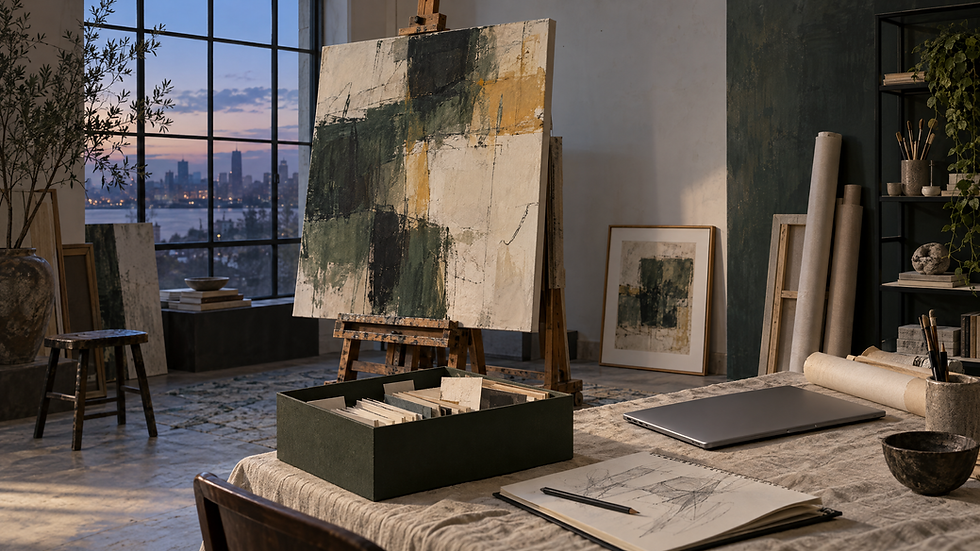
Image disclosure: This is an original editorial illustration, not a documentary photograph, artwork reproduction or exhibition view.
At the Venice Biennale, Adebunmi Gbadebo brings clay made from an ancestral South Carolina burial ground into an argument about who gets to shape the material record of slavery—and what an artwork can, and cannot, return.
This analysis draws on official exhibition documentation, published interviews, criticism, and institutional records. It does not claim a visit to Venice or the artist’s studio.
The most consequential fact about Adebunmi Gbadebo’s appearance at the 61st Venice Biennale is not simply that she is among 110 invited participants. It is that the material at the centre of her presentation has already had another life, and another jurisdiction. For In Minor Keys, the Biennale’s exhibition conceived by Koyo Kouoh and open in Venice through 22 November, Gbadebo has brought a practice rooted in the red soil of a South Carolina burial ground into the Central Pavilion.[1] [2] That passage—from a site of family burial and forced labour to a global exhibition’s most public room—makes provenance the work’s active form, rather than a line in a checklist.
La Biennale identifies the soil as earth dug from burial plots at the former True Blue plantation, where Gbadebo says her ancestors were enslaved. Mixed by hand into clay, it becomes vessels; some incorporate rice, while others contain human hair and afro locs. The institution also describes screenprints and paper works made with handmade inks and pigments around these objects, evoking the watery landscape around the plantation.[2] The wording is careful but ambitious: the vessels are described as funerary objects, made to commemorate family and “restore the land.” It offers a powerful account of what the work intends. It does not pretend that a Biennale display can settle the land’s history.
That difference is essential. A vessel can concentrate time, touch and evidence, but it cannot deliver a legal or moral resolution by virtue of being made from charged matter. Gbadebo’s achievement is not that she makes red clay stand in for a past otherwise unavailable. It is that she refuses the clean separation between a contemporary art object and the conditions by which its materials reached a viewer. In Venice, the question is not only what these forms mean. It is what it asks to move a material once shaped by extraction into a place that expects art to circulate.
An archive that does not stay on paper
Gbadebo’s materials were never ornamental accents to an otherwise conventional studio practice. In 2020, her first New York solo exhibition, A Dilemma of Inheritance, included more than 45 works concerned with two South Carolina plantations connected to her family history. Culture Type recorded paired 21-part installations made with human hair, cotton, rice paper and indigo dye—abstracted portraits of generations who endured enslavement.[3] The point of that combination was neither illustration nor historical décor. Cotton, rice and indigo were commodities; hair carried a bodily specificity that a plantation ledger could not contain.
In a 2023 interview with IFAcontemporary, Gbadebo explained that her early “history papers” screened wills and appraisal lists alongside hair, after ancestry research led her to True Blue. Those documents included relatives among property and animals. The artist’s response was not to repair the archive by filling it with seamless biography. It was to alter the archive’s material address: paper becomes a surface where a record of possession meets a substance associated with personhood, donation and care.[4] Her work proposes that abstraction can be exact. It can withhold an illustrative scene while retaining the friction of its source.
That paper practice makes the Biennale’s use of clay easier to understand. Clay is not a picturesque return to earth, and the vessels are not simply archives with handles. They turn the problem from legibility to form. A document can name a person and still reduce them to property. A hand-built container cannot undo that violence, but it can make the viewer confront density, volume and fragility where an archive has made lives flat. The move from cotton pulp and printed record to a fired vessel changes the scale of attention: one reads a sheet; one circles an object.
Learning from Edgefield without turning history into style
Gbadebo’s method is often framed through two histories of making. The Biennale connects her hand-mixing of clay to the Old Edgefield potters of South Carolina, African American ceramicists who developed their work under enslavement, and identifies Nigerian and Cameroonian coil methods in her construction.[2] These references should be understood as technical and historical commitments, not as an all-purpose aesthetic of ancestry.
The distinction matters because craft history has often treated African-derived technique as an image bank while separating it from the people, labour and constraints that made it. Gbadebo’s account of coiling to IFAcontemporary is resolutely procedural: thick coils are worked with water inside the vessel and pressed upward rather than being attached through the familiar scored seam. In some uses of the technique, the maker moves around a vessel that remains on the ground.[4] The body’s position is part of the knowledge. So is the fact that a method is not a static inheritance but a practice learned, adapted and made accountable in the present.
Her participation in Hear Me Now: The Black Potters of Old Edgefield, South Carolina sharpened this relationship before Venice. The Museum of Fine Arts, Boston described the travelling exhibition as a gathering of roughly 60 nineteenth-century objects from Old Edgefield alongside contemporary responses; Gbadebo appeared with artists including Simone Leigh, Woody De Othello and Robert Pruitt. Its record identifies her 2021 K.S. as True Blue cemetery soil with human locs.[5] Rather than position her as a descendant in a neat line from an older craft, the exhibition placed a contemporary object amid a more difficult field: authorship under enslavement, unnamed makers, David Drake’s signed jars and the uneasy category of objects designated as utilitarian ware.[5] [6]
Gbadebo’s first solo exhibition with Nicola Vassell Gallery, Watch Out for the Ghosts (4 September–18 October 2025), showed what she can do when that history becomes less a curatorial category than a problem of surface. Writing in The New Yorker, Doreen St. Félix described ovoid containers and the tactile aftershock of their skins: rice could fill mouths or emerge from the exterior; hair, pine needles, seeds, bone and branches disturbed any polite definition of ceramic material. She also reported the artist’s laborious conversion of hand-dug soil into workable clay, with secondary clays and water added before forming and firing.[6] [9] The account complicates the Biennale’s compressed language of “resonant materials.” Resonance here is not an aura. It is the result of actions—digging, sifting, mixing, coiling, firing—that expose the medium’s resistance.
The material is not an alibi
This is why the Venice presentation deserves more than the familiar praise reserved for art about inherited trauma. Gbadebo neither stands outside the plantation economy’s afterlife nor packages its signs as a mood. She works through things that plantation capitalism made valuable—rice, cotton, indigo—and changes their relation to value. A 2023 response to Remains noted the way her Productions paper series paired the violence of indigo production in the American South with a longer Nigerian dyeing tradition that predates U.S. slavery.[7] The comparison prevents the plantation from becoming the sole origin story for Black knowledge. It insists on cultural histories that the plantation depended upon but did not invent.
There is a parallel caution in the Biennale context. Venice is brilliant at turning artworks into occasions: national narratives, grand visits, fast circulations of images and institutional endorsement. A vessel made from burial-ground soil risks being received as an exceptionally eloquent object whose provenance readers admire before moving on. Gbadebo’s materials resist that ease, but they cannot guarantee an ethical spectator. No exhibition label, however precise, restores ownership of a burial site, clears an archive’s omissions or makes consumption into repair. The claim for art must be smaller and more serious: it can make the terms of looking harder to evade.
That is also where the forms matter. The Biennale’s own description does not reduce the work to a single monument; it pairs vessels with paper, pigment and screenprint.[2] Such plurality prevents a single heroic object from carrying a whole lineage. The work’s different substances also have different tempos. Hair is collected and carried. Rice is grown, traded, cooked and stored. Pigment disperses. Clay is shaped while wet, then altered irrevocably by heat. To place these materials together is not to declare that they speak in one voice. It is to insist that history is encountered through incompatible kinds of evidence.
Gbadebo’s trajectory makes that insistence newly visible, but it did not begin with Venice. Her early New York presentation developed a vocabulary of hair, cotton, rice paper and indigo; Hear Me Now put her work in a major museum conversation on Black ceramic histories; the 2025 gallery exhibition tested the vessels’ physical and critical force; and now the Central Pavilion gives this materially exact practice an international frame.[3] [5] [6] A 2024 United States Artists profile, written before the Biennale invitation, already described a multimedia practice concerned with land, matter and memory at sites of slavery, alongside a 2023 Maxwell/Hanrahan Award in Craft.[8] The more accurate story, then, is not a sudden arrival. It is of a practice whose questions have acquired a larger room.
Kouoh’s title, In Minor Keys, asks for attention to registers of listening that can be intimate without being quiet. Gbadebo’s work makes that proposition physically difficult. It asks a viewer to notice the difference between clay as a generic medium and clay made from a named place; between cultural inheritance as a flattering description and history as a contested set of materials; between commemoration and repair.[1] Venice does not absolve that tension. It gives it an audience. The red clay keeps nothing by itself. What matters is the refusal to let its movement become invisible.
Sources & records
1. https://www.labiennale.org/en/art/2026 "La Biennale di Venezia: Biennale Arte 2026, In Minor Keys"
2. https://www.labiennale.org/en/art/2026/adebunmi-gbadebo "La Biennale di Venezia: Adebunmi Gbadebo"
3. https://www.culturetype.com/2020/10/03/a-dilemma-of-inheritance-adebunmi-gbadebo-employs-abstraction-and-non-traditional-materials-to-mine-memories-and-histories-of-enslavement/ "Culture Type: A Dilemma of Inheritance"
4. https://ifacontemporary.org/molding-the-past-and-present-a-conversation-with-adebunmi-gbadebo/ "IFAcontemporary: Molding the Past and Present, a conversation with Adebunmi Gbadebo"
5. https://www.mfa.org/exhibition/hear-me-now-the-black-potters-of-old-edgefield-south-carolina "Museum of Fine Arts, Boston: Hear Me Now—The Black Potters of Old Edgefield, South Carolina"
6. https://www.newyorker.com/culture/critics-notebook/adebunmi-gbadebo-and-the-mysteries-of-clay "The New Yorker: Adebunmi Gbadebo and the Mysteries of Clay"
7. https://tatter.org/a-critical-history-of-blue-remains-by-adebunmi-gbadebo/ "Tatter: A Critical History of Blue—Remains by Adebunmi Gbadebo"
8. https://www.unitedstatesartists.org/artists/adebunmi-gbadebo "United States Artists: Adebunmi Gbadebo"
9. https://www.nicolavassell.com/exhibitions/32-adebunmi-gbadebo-watch-out-for-the-ghosts/ "Nicola Vassell Gallery: Adebunmi Gbadebo, Watch Out for the Ghosts"

$50
Product Title
Product Details goes here with the simple product description and more information can be seen by clicking the see more button. Product Details goes here with the simple product description and more information can be seen by clicking the see more button

$50
Product Title
Product Details goes here with the simple product description and more information can be seen by clicking the see more button. Product Details goes here with the simple product description and more information can be seen by clicking the see more button.
$50
Product Title
Product Details goes here with the simple product description and more information can be seen by clicking the see more button. Product Details goes here with the simple product description and more information can be seen by clicking the see more button.


Comments