AI’s Local Cost Question: What We Know About Data Centers, Power, and Water
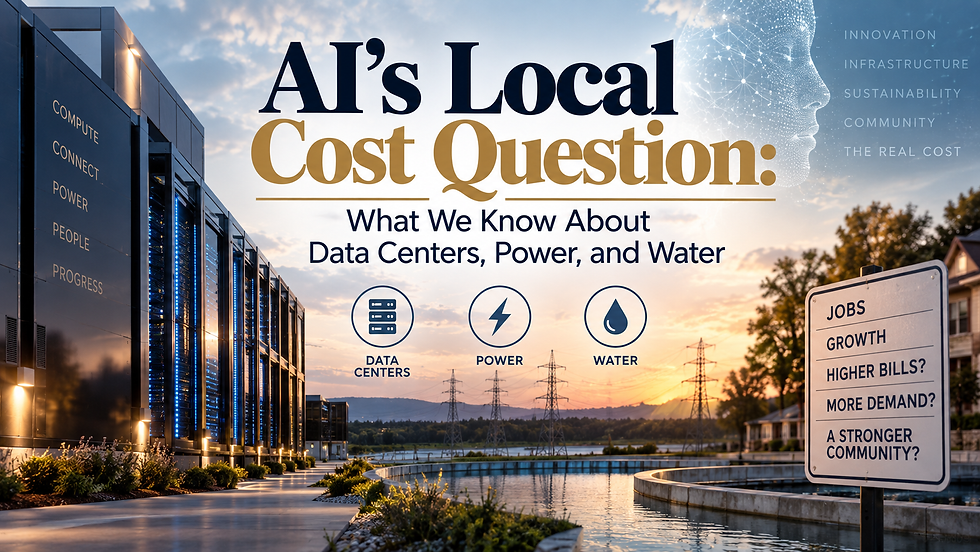
Artificial intelligence can feel weightless: a prompt, a search, a generated image. The buildings that make much of it possible are not. Data centers occupy land, draw steady electricity, require connections and backup equipment, and may use water according to their cooling design and power supply. As projects reach county agendas, a practical question follows: who benefits, who carries which costs, and who gets a meaningful say?
The answer differs by place. Size, cooling, water source, local grid, tax agreement, and permit conditions matter. It is inaccurate to say every data center raises bills or threatens a water supply, and just as inaccurate to dismiss local concern. Good decisions need records, clear terms, and an honest count of benefits and public obligations.
National concern is real, but it is not a local verdict
A new AP-NORC/University of Chicago Energy Policy Institute survey is a national snapshot, not proof that a particular project will harm a town. Conducted July 6–24 among 3,424 adults, it found 53% extremely or very concerned about AI’s environmental effects, up from 41% in 2025. On data centers, 84% expressed concern about local electricity prices, 79% about water supply, and 78% about power outages. The overall margin of sampling error was plus or minus 2.2 percentage points.
On policy, 73% supported requiring data centers to cover grid-upgrade costs, 65% backed clean-energy requirements, and 62% favored limits on new construction. These are survey preferences, not a zoning verdict or proof that a company has done wrong.
Gallup found similarly strong reaction in a separate March telephone survey: 71% opposed a local AI data center, including 48% strongly. Opponents often named water, energy, pollution, quality of life, or possible utility costs; supporters most often cited jobs and economic benefits. Gallup’s 1,000-adult sample had a four-point margin of sampling error, and the organization cautions that wording and other errors affect polls.
The two polls do not tell us which project should be approved. They do tell officials and developers something worth hearing: people want the particulars before they accept the tradeoff.
Power demand is documented; household effects are not automatic
Data centers are not ordinary commercial customers. Servers run continuously, and AI workloads can concentrate very large demand in one place. The Department of Energy reported that data centers used about 176 terawatt-hours in 2023—4.4% of U.S. electricity use. Its 2028 range, 325 to 580 terawatt-hours or 6.7% to 12% of national use, is a forecast, dependent on assumptions about computing growth, efficiency, and construction.
Berkeley Lab’s 2030 estimate is likewise a scenario-based forecast: 11.8% of U.S. electricity use, with a 9.5%–15.3% range. A national percentage cannot say what one campus will require from local feeders, substations, transmission, or generation.
A large load can require grid investment. It does not follow that a nearby resident’s bill has already increased because a data center is proposed or built. Rates depend on state systems, filings, contracts, and regulatory decisions. The concrete questions are which upgrades are needed, what they cost, and how costs are assigned.
Pennsylvania’s Public Utility Commission offers one policy example. Its April framework covers customers above 50 megawatts individually or 100 megawatts in aggregate. It calls for direct recovery of necessary interconnection-upgrade costs from large-load customers, backed by financial assurances, and public queues showing applications, megawatts, and stage. It is not a national rule, but shows that cost allocation can be made visible rather than assumed.
Water requires careful words and local data
Water claims are often the least clear part of the debate. A data center may use water directly for cooling. Its electricity supply may also entail water use at power plants. Berkeley Lab’s model treats those as distinct but connected parts of a location-specific water footprint, shaped by cooling technology and power-supply conditions.
The words withdrawal and consumption are not interchangeable. The U.S. Geological Survey defines consumptive use as water withdrawn that evaporates, is incorporated into products, or is otherwise not immediately available for use. Some water is returned to a source; some is not. A recirculating, or closed-loop, cooling system reuses water in a process, but that does not mean it has no water demand or no evaporation losses.
This is why a national gallons figure cannot settle a local dispute. An ample reclaimed-water system poses a different question from a limited aquifer. A proposal may use drinking water, reclaimed wastewater, a self-supplied well, or a combination. Records should identify the source, permitted quantity, seasonal pattern, discharge or reuse plan, supply assumptions, and drought conditions.
Residents deserve more than a slogan about “water use.” A company should be judged by its actual design and enforceable commitments, not a generic figure from another climate or cooling system.
Jobs and infrastructure are benefits—and questions—not a blank check
The economic case deserves the same specificity. Construction can create work for trades, suppliers, and nearby services, while permanent operations jobs may have a different scale and skill mix. Tax revenue, road work, broadband, and workforce programs may be benefits, but an announcement is not an outcome. Gallup found that supporters often cited jobs and economic gains; AP-NORC/EPIC found mixed public assessments of job-creation benefits.
Communities can compare anticipated construction work, expected permanent positions, disclosed wages and training, incentives, utility work, and responsibilities if a project slows.
They can ask whether a new substation, pipeline, or transmission expansion serves wider reliability needs or is an interconnection cost for one large customer. Those are document questions, not guesses about intent.
Permits are where public promises become testable
“Data center” can hide several decisions. Local boards may consider rezoning, conditional use, site plans, noise, traffic, setbacks, and substations. State agencies may review backup-generator air permits, water, wastewater, wetlands, or other effects. A utility regulator may review resource plans, rates, or large-load arrangements. Each has its own record and comment period.
Loudoun County, Virginia, shows a local government revisiting rules as development expands. In 2025, following a review begun in 2024, the county changed data centers in areas previously allowed by right into conditional or Special Exception uses. Its second phase is considering further policy and use-specific standards. The county posts materials, an application guide, comments, staff reports, and meetings; Planning Commission consideration is expected in February 2027.
Virginia’s Department of Environmental Quality maintains an issued-air-permit list for data centers and identifies regional staff and a Freedom of Information Act route for additional records. For qualifying applications received on or after July 1, 2026, its revised guidance sets presumptive control requirements for data-center diesel generators, including controls for nitrogen oxides, carbon monoxide, and particulate matter. A permit is a regulatory decision, not a guarantee that every concern is resolved.
Read staff reports and applications, not just renderings or viral claims. Look for measurable conditions: water draw, noise, monitoring, construction route, landscaping deadline, or interconnection responsibility. Ask who inspects and enforces them.
A practical record trail for any community
Start with the planning agenda, case number, staff report, zoning map, and hearing calendar. Then find the utility’s integrated resource plan and the state utility-commission docket. Virginia’s State Corporation Commission describes an integrated resource plan as a 15-year load forecast and a plan to meet it through supply- and demand-side resources; its proceedings have included written and oral public comments.
For environmental records, search the responsible state agency and local water utility. Virginia’s Permit Transparency portal can be filtered by application, applicant, facility, agency, locality, date, and status—enough to distinguish a pending application from a completed one.
Save the agenda packet, permit number, maps, water and power estimates, and posting dates. When a claim is unclear, ask the agency for its source document or use public-records procedures. The point is not to presume guilt; it is to make consequential choices legible while they can still be shaped.
My measured view
In my view, a community is not anti-technology because it asks whether a large, resource-intensive project belongs in a particular place. Nor is every supporter indifferent to neighbors or the environment. The honest moral task is more demanding: take both the promise of useful computing and the everyday claims of people who will live near the buildings seriously.
I am persuaded that public decisions should be slower than marketing language and clearer than rumor. A facility that brings construction work, tax revenue, and computing capacity may be a real benefit. Those benefits do not erase questions about water during a dry season, power-system costs, generator emissions, noise, land use, or whether commitments can be enforced. Conversely, an alarming national estimate should not substitute for a local water balance, a utility study, or a permit record.
The fair standard is not automatic approval or automatic rejection. It is honest disclosure early enough for residents, workers, local businesses, utilities, and officials to examine the terms together. Companies asking a community to host essential infrastructure should expect to show their work. Public bodies entrusted with permits should make it possible for ordinary people to see it. That is not obstruction. It is neighborliness practiced through public accountability.
AI may arrive through a screen, but its infrastructure arrives through a road, a power line, a water system, and a public agenda. Communities do not need panic or blind faith. They need the facts, the records, and enough time to ask what a durable bargain requires.
References

$50
Product Title
Product Details goes here with the simple product description and more information can be seen by clicking the see more button. Product Details goes here with the simple product description and more information can be seen by clicking the see more button

$50
Product Title
Product Details goes here with the simple product description and more information can be seen by clicking the see more button. Product Details goes here with the simple product description and more information can be seen by clicking the see more button.
$50
Product Title
Product Details goes here with the simple product description and more information can be seen by clicking the see more button. Product Details goes here with the simple product description and more information can be seen by clicking the see more button.


Comments